Your Global Finance Career is Loading…

Understanding the ACCA Course Structure for 2025: A Breakdown of the Key Papers with Finplan Edu

As the financial and accounting landscape evolves, the ACCA (Association of Chartered Certified Accountants) course remains a premier qualification for those seeking global opportunities in finance, accounting, and business. The ACCA course is recognized worldwide, offering a well-rounded education that equips students with both technical knowledge and practical expertise. In this article, we’ll explore ACCA Course details, focusing on its structure, key papers, and why partnering with Finplan Edu is your best step forward for success in 2025.

Quick Snippets

ACCA Course Structure for 2025

ACCA Course Structure at a Glance

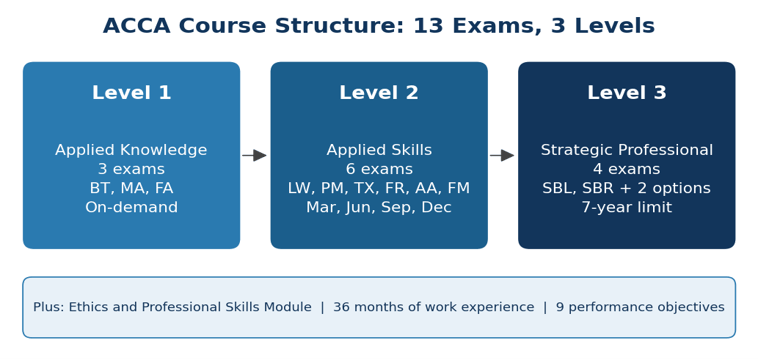
The ACCA course structure is built around 13 exams that sit in three progressive levels. If you are wondering how many levels there in ACCA are, the answer is three: Applied Knowledge, Applied Skills and Strategic Professional. Each level builds on the one before it, so the ACCA curriculum moves from basic business and accounting ideas to leadership and strategy. Alongside the exams, you complete an ethics module and gain work experience before you become a full member. The table below shows how the ACCA structure fits together. You can check the latest version on the official ACCA qualification page.


Level

Exams

Exam format

Applied Knowledge

3

Computer-based, on demand

Applied Skills

6

Computer-based, in March, June, September and December

Strategic Professional

4

Session-based, with a 7-year limit once you pass your first paper

Total

13

Plus ethics module and work experience


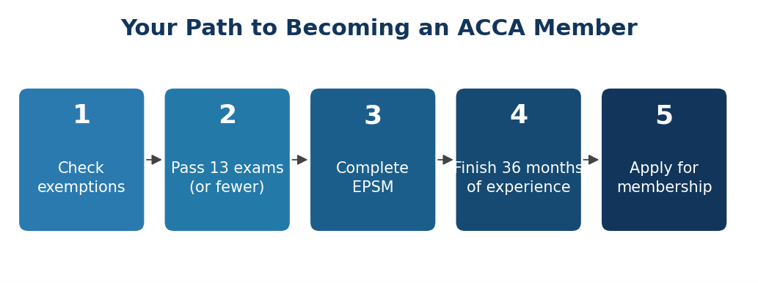
A full ACCA qualification includes these parts:

•    Three levels, Applied Knowledge, Applied Skills and Strategic Professional, with 13 exams in total.

•    The Ethics and Professional Skills Module, an interactive online module that builds business, ethical and leadership skills.

•    The Practical Experience Requirement, which means at least 36 months of relevant work signed off by a qualified supervisor.

•    Nine performance objectives that you complete while working, to show you can apply what you have learned.

•    Possible exemptions from up to 9 exams, depending on earlier studies such as a B.Com, BBA, or CA Foundation or Intermediate.
ACCA Levels and Subjects Explained

Here is a closer look at the ACCA levels and subjects. The sections below go through each level in order.

ACCA Levels and Subjects Explained


Applied Knowledge Level (3 Exams)
The first level has three papers: Business and Technology (BT), Management Accounting (MA) and Financial Accounting (FA). BT explains how organisations work and how technology supports them. MA covers costing and the techniques managers use for planning and control. FA shows you how financial statements are prepared. These exams are computer-based and on demand, so you can sit them whenever you feel ready.

Applied Skills Level (6 Exams)
This level has six papers: Corporate and Business Law (LW), Performance Management (PM), Taxation (TX), Financial Reporting (FR), Audit and Assurance (AA) and Financial Management (FM). They turn the basics into skills you will use at work, such as tax computation, audit risk and investment appraisal. Exams are computer-based and offered in March, June, September and December. FR and AA usually need the most study time, so it helps to pair them with lighter papers.

Strategic Professional Level (4 Exams)
The final level has two compulsory papers, Strategic Business Leader (SBL) and Strategic Business Reporting (SBR). You then choose any two options from Advanced Financial Management, Advanced Performance Management, Advanced Taxation and Advanced Audit and Assurance. Exams are session-based, and you have seven years to finish this level once you pass your first paper. The table compares the four options so you can pick the right pair.


Option paper

Best suited to

Main focus

Advanced Financial Management (AFM)

Corporate finance and treasury roles

Investment decisions, risk and valuation

Advanced Performance Management (APM)

Management and consulting roles

Performance analysis and strategy

Advanced Taxation (ATX)

Tax advisory careers

Complex tax planning for individuals and companies

Advanced Audit and Assurance (AAA)

Audit and assurance careers

Audit risk, ethics and professional judgement

ACCA Exam Levels: How to Plan Your Order of Papers

The ACCA exam levels are meant to be taken in sequence, so you should finish one level before starting the next. A good plan balances heavy papers with lighter ones so you do not burn out. Working students usually take one or two exams per session, while full-time students can take more. Here is a simple way to sequence your papers:

•    Start with the three Applied Knowledge papers, because they teach the vocabulary you need for everything that follows.

•    Avoid sitting Financial Reporting (FR) and Audit and Assurance (AA) in the same session if you work full time, since both need long study hours.

•    Take Performance Management (PM) before Advanced Performance Management (APM), because APM assumes you already know the PM material.

•    Choose your Strategic Professional options to match your career goal, such as AFM for finance roles, ATX for tax or AAA for audit.

•    Sit at least one full mock exam in the final weeks of revision, so you can check your timing before the real paper.

ACCA Course Duration and Exam Timetable

Most students take about three to five years to complete the ACCA course duration, although exemptions can shorten this. Applied Knowledge exams are on demand, so you can book them almost any time. Applied Skills and Strategic Professional exams run in four sessions each year, in March, June, September and December. The ACCA exam timetable with exact dates and booking deadlines is published by ACCA, so check it before you plan. The ACCA syllabus PDF and study guide for each paper are free to download from the ACCA website. The work experience requirement runs alongside your exams, and you can complete the 36 months before, during or after your studies.


ACCA Course Duration and Exam Timetable

ACCA Course Structure and Fees: What You Will Pay For

People often search for ACCA course structure and fees together, and for good reason. Your total cost depends on how many exams you need, whether you qualify for exemptions and which training provider you choose. ACCA sets its own fees and changes them every year, so always confirm current amounts on the ACCA website. Tuition fees are separate and vary by provider. Here are some ways to keep costs down:

Cost item

What it covers

Planning tip

Registration

One-time fee to become an ACCA student

Pay it when you are ready to start

Annual subscription

Yearly fee to stay registered

Budget for it every year

Exam fees

Charged per paper, per sitting

Book only when your mock scores are steady

Exemption fees

Fee for each paper you are exempted from

Compare it with the cost of studying the paper

Tuition and materials

Classes, notes and mock exams

Compare providers before you pay


•    Check your exemption eligibility first, because every exempted paper cuts study time and exam sittings.

•    Sit each exam only when your mock scores are consistently good, since resits add fees and delay your progress.

•    Use the free ACCA syllabus, study guides and practice resources before you buy extra material.

•    Pick tuition that fits your schedule, because online classes can save you travel and accommodation costs.

•    Spread your exams across sessions, so that fees and study load stay manageable.

Exemptions, Ethics Module and Practical Experience

Passing the exams is not the only step to becoming an ACCA member. You also need to meet a few other requirements, and some students can skip part of the exam route.

Exemptions Based on Your Background
Depending on your academic background, you may be eligible for up to 9 exam exemptions. Degrees such as B.Com or BBA and qualifications such as CA Foundation or Intermediate are commonly reviewed for this. Each exemption removes a paper from your plan, which shortens the ACCA course duration. ACCA decides exemptions case by case, so apply with your documents and confirm the result before you pay for classes.

Ethics Module and Work Experience
The Ethics and Professional Skills Module is an interactive online module that develops business, ethical and leadership skills. The Practical Experience Requirement needs at least 36 months of relevant work. A qualified supervisor signs off your experience, and you complete 9 performance objectives along the way.

ACCA Online Courses with Finplan Edu

If you want flexibility, ACCA online courses are a practical choice. Online learning ACCA programmes let you study from home while still getting structured classes and support. Finplan Edu is a platinum-approved ACCA partner with more than 10 years in professional education. It reports a 96% learner satisfaction rate. Students from Mumbai, Thane, Pune, Hyderabad, Bangalore, Chennai, Delhi, Kolkata, Ahmedabad, Kerala and Surat can join. You can read more about the awarding body on Wikipedia. Here is what the programme offers:

•    Platinum-approved status, so the training follows the standards set by ACCA.

•    Experiential learning through hands-on projects, case studies and mentoring from industry professionals.

•    Support across all three levels, from Applied Knowledge to Strategic Professional.

•    A learner community of 9,500+ students.

•    Placement support through an employer network of 350+ companies, with placement protection for ACCA graduates.

Frequently Asked Questions

1. How many levels are there in ACCA?

There are three: Applied Knowledge, Applied Skills and Strategic Professional. Together they include 13 exams.

2. What are the ACCA exam levels and how many papers are in each?

Applied Knowledge has 3 papers, Applied Skills has 6, and Strategic Professional has 4. Two Strategic Professional papers are compulsory.

3. Which papers are compulsory at Strategic Professional?

Strategic Business Leader (SBL) and Strategic Business Reporting (SBR) are both required. You then pick any two from AFM, APM, ATX and AAA.

4. How long does the ACCA course take?

Most students need about three to five years. It depends on your exemptions and exams per session.

5. Where can I find the ACCA syllabus PDF?

>ACCA publishes the syllabus and study guide for every paper on its website. They are free to download.

6. When is the ACCA exam timetable?

Applied Knowledge exams are on demand. Applied Skills and Strategic Professional exams run in March, June, September and December, so check ACCA for exact dates.

7. What does the ACCA course structure and fees include?

ACCA charges registration, an annual subscription and per-exam fees. Tuition is separate, and amounts change each year, so confirm them before budgeting.

8. Can I get exemptions from some papers?

Yes, you may get up to 9 exemptions based on studies like a B.Com, BBA, or CA Foundation or Intermediate.
9. Can I study ACCA online if I live in Pune, Chennai or Kerala?

Yes. ACCA online courses from Finplan Edu are open to students in Mumbai, Thane, Pune, Hyderabad, Bangalore, Chennai, Delhi, Kolkata, Ahmedabad, Kerala and Surat.

10. Do I need work experience to qualify?

Yes. You need 36 months of relevant experience, 9 performance objectives and the Ethics and Professional Skills Module alongside your exams.


Ready to Plan Your ACCA Journey?

Pick a level, check your exemptions and build a study plan that fits your schedule. The team at Finplan Edu can walk you through each step, so visit finplanindia.com to get started. You can also email enquiries@finplanindia.com, call 9029007248 or find the office on Google Maps.

Have questions? Contact us