Your Global Finance Career is Loading…

ACCA 2027 Changes: Complete Guide to the New Exam Structure, Employability Modules, and PER Updates

A practical, student-focused breakdown of what's changing, when, and what to do at every stage of your ACCA journey. If you're studying for ACCA right now, or thinking about starting soon, you've probably heard about the 2027 changes and felt unsure what they mean for you. That's fair. ACCA doesn't overhaul its structure often, so this update touches everything from exam count to work experience rules. This guide breaks down what's changing, when it takes effect, and what to do depending on your stage.

Quick Snippets

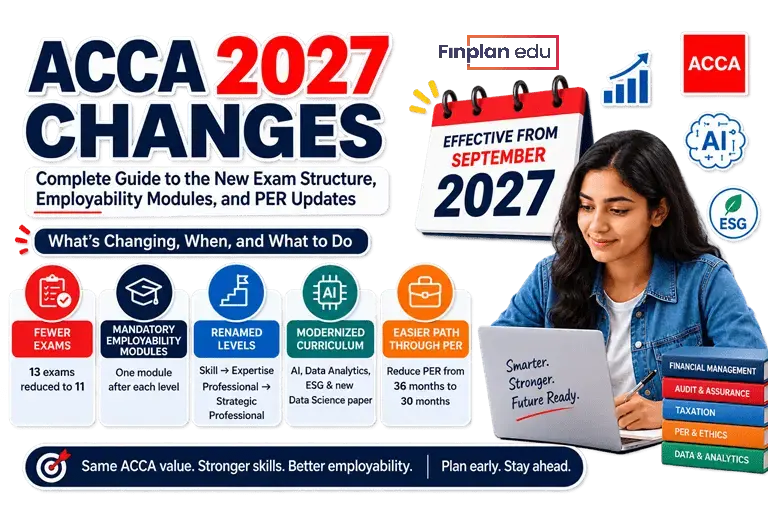
Finplan Edu graphic explaining key ACCA changes from 2027, including exams, skills, and employability.

1. What's Changing in ACCA From 2027 (The Big Picture)

ACCA announced structural changes rolling out through 2027, and they affect nearly every stage of the qualification. The changes aren't cosmetic. They touch how many exams you sit, what you must complete alongside them, what the levels are called, and how your work experience is calculated. None of this makes the qualification less valuable. ACCA is reshaping the course to match what employers want today, including comfort with AI, data analytics, and ESG reporting. Students already partway through don't need to worry, since anything already cleared stays valid. Here's a quick summary of the five biggest shifts.

  • Fewer total exams. ACCA is reducing the qualification from 13 exams to 11, mainly by trimming one paper at Strategic Professional level and removing Business and Technology (BT) for new Knowledge-level students.
  • New mandatory employability modules. Instead of just today's single ethics module, students must now clear a dedicated employability module after each level before moving to the next.
  • Renamed qualification levels. Skill level becomes Expertise level, and Professional level becomes Strategic Professional level, while Knowledge level keeps its name.
  • A modernized curriculum. ACCA is weaving AI, data analytics, and ESG concepts across the syllabus, plus adding a new optional data science paper.
  • An easier path through PER. An optional employability module can reduce your required work experience from 36 months to 30 months.

2. Why ACCA Exams Are Reducing From 13 to 11

The most talked-about change is the drop in exam count, so it's worth seeing exactly where those two exams disappear from. At Strategic Professional level (formerly Professional level), students currently pick two optional papers from four: Advanced Financial Management, Advanced Taxation, Advanced Audit, and Advanced Performance Management. The new structure expands that pool to five options with a data science paper added, but students only choose one instead of two. The compulsory papers, SBR and SBL, stay exactly as they are. The Knowledge-level Business and Technology paper is also removed entirely for new students. Fewer papers doesn't mean a lighter qualification, since ACCA intends to keep the rigor per paper consistent with the old standard.

Level

Current Structure (Before June 2027)

New Structure (From September 2027)

Knowledge Level

Includes Business and Technology (BT) paper

BT removed for new students

Skill / Expertise Level

Same core papers, current name

Same core papers, renamed "Expertise Level"

Professional / Strategic Professional Level

4 papers: 2 compulsory (SBR, SBL) + 2 optional from 4

3 papers: 2 compulsory (SBR, SBL) + 1 optional from 5

Total Exams

13

11

3. New ACCA Employability Modules Explained

Alongside the reduced exam count, ACCA is introducing a genuinely new requirement rather than just a trim. Right now, students have one mandatory non-exam component, the ethics module, usually completed near the end since it's a prerequisite for membership. Going forward, that single module is replaced by employability modules cleared after each level, not just once at the end. This moves the checkpoint from a one-time final hurdle to something built into every stage of progress.

How the Mandatory Modules Work

You'll complete one module after Knowledge level, another after Expertise level, and a third after Strategic Professional level, and all three are compulsory. Each is self-paced through the myACCA portal, so you work through the content on your own schedule. To pass, you need 50 out of 100, and you can retake it without an extra fee if you don't clear it first try. You cannot begin exams at the next level until the module for your current level is cleared.

The Optional Employability Module

Beyond the three mandatory modules, ACCA is introducing an optional module tied directly to your work experience requirement. Full details haven't been released, but its purpose is clear: it substitutes for part of your practical experience, covered next. Pricing hasn't been announced, though it's expected to be chargeable like the current ethics module.

4. Changes to the Practical Experience Requirement (PER)

Your Practical Experience Requirement is getting a genuinely useful update too. Currently, PER has three parts: 36 months of relevant work experience, performance objectives, and the ethics module. Under the new system, the ethics module is absorbed into the employability module structure rather than existing separately. Performance objectives aren't changing, so progress you've already documented still counts. The headline change is that the optional employability module lets you reduce work experience from 36 to 30 months, a real saving for working professionals balancing a job with their studies. Here's what's actually shifting.

  • Work experience duration. Standard requirement stays 36 months, but the optional module reduces it to 30 months for eligible students.
  • Ethics module. No longer exists as a separate PER component, since ethics content is now folded into the mandatory employability modules.
  • Performance objectives. Remain completely unchanged, so any progress you've made carries forward without adjustment.
  • Module pricing. Not yet confirmed by ACCA for either mandatory or optional modules, so budget with some flexibility for now.
  • Eligibility timing. The optional module can be completed at any point in your PER journey, giving you flexibility in when you use it.

5. Key ACCA 2027 Deadlines and Transition Timeline

Timing is where most student confusion comes from, so the exact dates are worth laying out clearly. For Skill and Professional level papers, June 2027 is the final attempt under the current structure. September 2027 marks the first sitting under the new Expertise and Strategic Professional structure. Knowledge level moves earlier, with the new structure beginning from the July 2027 attempt. If you're mid-way through papers at any level, nothing about your already-cleared exams changes, since ACCA confirms prior results remain fully valid. ACCA has also built a transition tool on its official website where you enter your progress and see how the new structure maps onto your situation.

Milestone

Date

What It Means for You

Last attempt, current Skill/Professional structure

June 2027

Final chance to sit these papers under the old 13-exam format

New Knowledge level structure begins

July 2027

BT removed for new students from this attempt

New Expertise/Strategic Professional structure begins

September 2027

11-exam structure and new optional paper pool take effect

Already-cleared papers

No expiry

Fully valid regardless of when the new structure begins

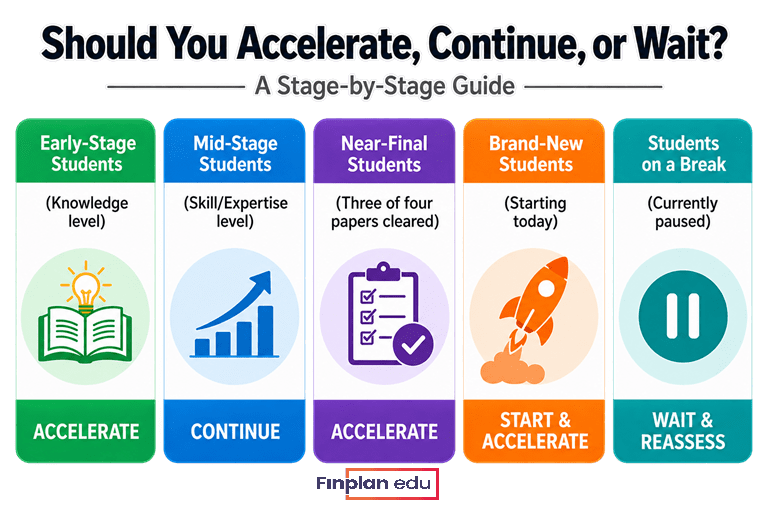
ACCA 2027 changes stage-by-stage guide for students, by Finplan Edu.

6. Should You Accelerate, Continue, or Wait? A Stage-by-Stage Guide

This is the question most students actually care about, and the honest answer depends on where you currently stand. There's no rule that fits everyone. One principle does hold up consistently though: waiting purely to skip one exam rarely makes financial sense. The income and experience gained by qualifying sooner usually outweighs the effort of one extra paper. Your specific stage does shift the calculation slightly, so it helps to see your situation mapped against the others below before deciding. Read through whichever one matches where you are right now.

  • Early-stage students (Knowledge level). You have the least to plan for, since by the time you reach Strategic Professional level, the new structure will likely already be active, giving you three papers instead of four automatically.
  • Mid-stage students (Skill/Expertise level). Continue exactly as planned, since your progress carries forward cleanly and you'll simply encounter the renamed "Expertise level" without real disruption.
  • Near-final students (three of four papers cleared). You could wait until June 2027 to skip your fourth paper, but finishing now and qualifying by December or March is usually smarter than delaying entry into the job market.
  • Brand-new students starting today. There's little reason to delay your start date, since the time lost waiting almost always costs more than the one paper you'd save.
  • Students currently on a break. A pause won't hurt you, and if the new structure is live when you return, you'll automatically benefit from fewer papers at Strategic Professional level.

7. What These Changes Mean for Employer Recognition and Career Prospects

A natural worry with any qualification change is whether it dilutes the credential's value, and that's understandable given how much weight ACCA carries in hiring. Based on how the changes are structured, the opposite seems more likely. Adding AI, data analytics, and ESG content means ACCA affiliates entering the job market will already know tools employers are hiring for right now. The new data science paper signals ACCA keeping pace with how finance teams actually operate, not teaching a version of the profession that's years behind. Bodies like ACCA, CFA, and ICAI have historically protected exam rigor even while trimming paper counts, and nothing suggests ACCA is breaking that pattern here. The employability modules, while extra work, are designed to make graduates more job-ready, a genuine advantage in interviews and early client work. Students qualifying under the new structure may even be slightly better positioned for MNC and GCC roles that increasingly expect AI-driven finance skills as a baseline.

Frequently Asked Questions

Will my ACCA papers that I've already cleared still be valid after 2027?

Yes. ACCA has confirmed that any paper you've already passed remains valid regardless of when the new structure takes effect, so you won't need to retake anything.

Do the 2027 changes make ACCA easier?

In raw exam count, yes, you'll sit two fewer papers. But ACCA has indicated each remaining paper's rigor will be maintained so the qualification's overall value doesn't drop.

Should I wait until 2027 to start ACCA?

For most new students, no. The months spent waiting to skip one paper usually cost more in delayed career entry than the paper itself takes to complete.

What happens to the current ethics module requirement?

It's absorbed into the new mandatory employability modules, completed after each level rather than as one standalone requirement near the end.

Can the optional employability module really reduce my work experience requirement?

Yes. Completing it reduces your Practical Experience Requirement from 36 to 30 months, though full pricing hasn't been officially announced yet.

Where can I check how these changes affect my personal study plan?

ACCA's official website has a transition tool where you input your progress and get a personalized breakdown of how the new structure applies to you.

Ready to Plan Your ACCA Journey the Right Way?

Structural changes like these are easier to navigate with a clear, personalized roadmap rather than guesswork. If you want help mapping your progress against the new 2027 structure, or you're deciding whether to start now or wait, our team at Finplan Edu can walk you through what makes sense for your specific stage and goals. Reach out anytime at enquiries@finplanindia.com or call 9029007248, or drop by our office to talk it through in person.

Have questions? Contact us