Your Global Finance Career is Loading…

AI in Accounting: The Complete Guide for Commerce Students (2026)

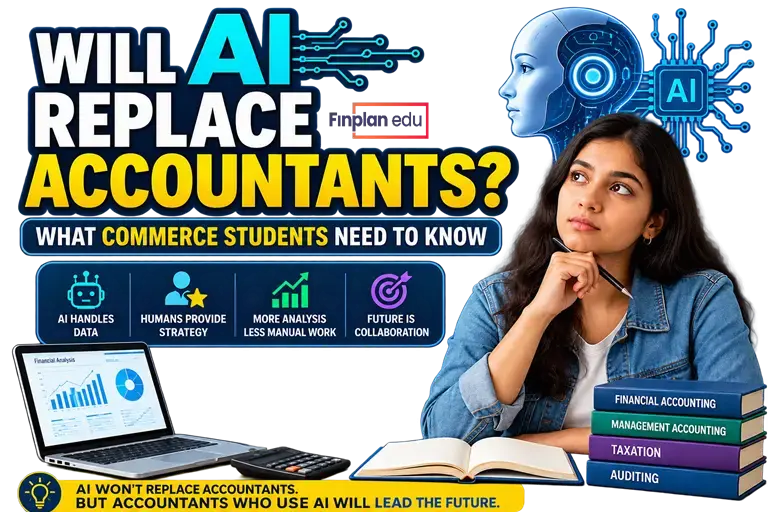
The Panic Is Real, and It's Everywhere.Scroll through Instagram or LinkedIn for five minutes and you'll find someone saying AI is about to wipe out accounting jobs. B.Com students hear it. (BAF) Bachelor of Accounting and Finance, ACCA, and CMA students hear it even more, because their whole career plan suddenly feels shaky. Someone posts a video of AI cleaning a messy Excel sheet in ten seconds, and the comments fill up with "so why am I even studying this?" Here's the honest part: that panic isn't baseless. AI genuinely can-do things that used to take an intern half a day. Watching it happen for the first time is a little jarring, even if you already knew AI was improving. But most of the fear online comes from people looking at half the picture. Once you break down what AI is doing versus what a finance professional does, the fear starts to lose its grip.

Quick Snippets

The Current Effects of AI in Finance

The Current Effects of AI in Finance

Let's be specific instead of vague. AI tools today can take a messy spreadsheet and clean it up in minutes. They can summarize a thirty page financial report into a few bullet points. They can build a basic dashboard without anyone touching a pivot table manually. Some can even write a decent first draft of a client email.

Notice something about that list? Every task on it is repetitive. It follows a pattern. There's no judgment call involved, no reading the room, no weighing what's good for the business versus what's good for the client. AI is fast at applying rules it already knows. It's not sitting there deciding what a company should do next quarter, and that gap is bigger than most people give it credit for.


Tasks AI Can Replace vs. Skills It Can't Touch

Split accounting work into two buckets and this whole debate gets a lot clearer. One bucket is mechanical, repeatable work. The other requires context, judgment, and reading people. AI has basically eaten the first bucket. It hasn't come close to the second.

  • Data entry and reconciliation: Same steps, every time. This is exactly the kind of work software has always been good at, AI just does it faster now.
  • Basic bookkeeping: Matching transactions against bank statements doesn't need deep thinking, so tools now handle this in a fraction of the time a person used to take.
  • Routine reporting: Pulling last month's numbers into a standard template is repetitive by design, which makes it an easy target for automation.
  • Financial interpretation: Figuring out *why* a number moved requires knowing the business, the market, and the people involved, none of which AI has access to.
  • Client relationships: Reading a nervous client, handling a tough negotiation, or calming someone down on a call isn't something a chatbot can fake convincingly.

If your entire skill set is data entry, basic Excel, and repetitive tasks, AI is genuinely coming for that role. No point sugarcoating it. But if you can look at numbers and explain what they actually mean for a business, AI stops being competition and starts being your assistant.

What Companies Actually Want from Finance Hires

Nobody's hiring purely to generate reports anymore. They want someone who can look at that report and tell them why sales dropped in the Delhi region, or why margins shrank even though revenue held steady. Those aren't spreadsheet questions. They're judgment questions, and judgment is exactly what separates someone who does accounting from someone who understands business.

That's why certain roles keep getting more valuable instead of less. Roles built around interpretation and strategy are holding up fine. Roles built purely around task completion are the ones under pressure.

Role

What It Involves

Why It's Holding Up

Financial Analyst

Studying performance, building forecasts

Needs context, not just calculation

FP&A

Budgets tied to business strategy

Requires judgment about the future

Audit

Checking records for accuracy

Needs skepticism, not just rule-following

Risk Management

Spotting where risk is building

Depends on understanding the specific business

Business Advisory

Advising companies on decisions

Built on trust and communication

Management Accounting

Supporting internal decisions

Connects numbers to real choices

The Skills Worth Building Right Now

Knowing which roles are safer doesn't help you unless you actually build the skills that keep you in that category. College theory alone won't cut it. Most colleges are still stuck on definitions and textbook formulas while companies want people who can walk in and solve a real problem on day one. It's a big part of why ACCA and CMA students tend to stand out, since those courses lean much harder into practical, industry facing skills.

Beyond the core finance basics, a few specific areas matter more than they used to.

  • Practical finance fundamentals: Financial statement analysis, budgeting, forecasting, taxation, and cost control aren't things you memorize once for an exam, they're things employers expect you to actually apply.
  • Advanced Excel and data tools: Knowing SUM and VLOOKUP isn't impressive anymore. Pivot tables, Power Query, macros, and Power BI are what turn raw numbers into something a manager can act on.
  • Smart AI usage: Letting AI clean data, draft reports, or summarize research saves real time, but the thinking and decision making still has to come from you.
  • Communication skills: Explaining a number clearly, negotiating without folding, presenting to people who aren't finance minded, these skills quietly decide who gets promoted.
  • Actual project experience: A real dashboard or forecasting model you built yourself says more to a hiring manager than another line of certifications on your resume.

Skill Area

What to Learn

Why It Matters

Core Finance

Statement analysis, budgeting, forecasting, taxation

Builds the practical base employers expect

Excel & Data Tools

Pivot tables, Power Query, Power BI, macros

Converts raw data into usable insight

AI Literacy

Cleaning, drafting, research, summarizing

Saves time for higher-value thinking

Communication

Presenting, negotiating, explaining numbers

Drives trust and career growth

Applied Projects

Dashboards, models, case studies

Proves skill in a way certificates can't

Using AI Without Letting It Use You

A lot of students swing between two extremes. Either they treat AI as a shortcut to avoid doing real work, or they treat it as some existential threat they can't compete with. Neither view is particularly useful. The smarter approach is treating AI like a fast intern: hand it the repetitive stuff, keep the thinking for yourself.

Let AI clean your data, draft your first version of a report, or spot a basic trend. That's not cheating, that's just using a tool for what it's built for. What AI still can't do is decide what a business should prioritize this quarter, or figure out how to phrase a hard message to a client without damaging the relationship. Those calls need someone who understands people, not just numbers. Students who get this distinction end up using AI as leverage. The ones who don't end up either scared of it or over-relying on it, and both approaches hold you back.

Building a Career AI Can't Touch

Building a Career AI Can't Touch

You don't need to wait for some future moment to start protecting your career. You can start now, while you're still studying, by building things that prove you can actually do the work instead of just describing it on paper. A certificate tells someone what you studied. A project tells them what you can do, and hiring managers care a lot more about the second one these days.

  • Power BI dashboards: Grab publicly available company data and turn it into something visual that tells a story at a glance.
  • Financial analysis write-ups: Pick a real company, dig into its financials, and write up what you find, trends, risks, whatever stands out.
  • Budgeting templates: Build something a small business could actually use, not a theoretical classroom exercise.
  • Automated Excel sheets: Use macros or Power Query to cut out repetitive manual work, and be ready to explain how it works.
  • Company case studies: Break down a company's financial decisions and what happened afterward, connecting the numbers to the strategy behind them.

None of this requires expensive tools or special access. It just requires you actually doing it instead of only reading about it. A portfolio built from work like this beats a resume full of certifications with nothing behind them.

Frequently Asked Questions

Will AI completely replace accounting jobs?

Not entirely. It's replacing repetitive, rule-based tasks like data entry and basic bookkeeping. Roles that need judgment, client handling, and interpretation are staying in demand.

Which finance roles are safest from AI right now?

Financial Analyst, FP&A, Risk Management, Business Advisory, and Management Accounting all lean on interpretation and strategy, which keeps them harder to automate.

Is ACCA or CMA still worth pursuing given how fast AI is moving?

Yes. These courses focus on practical, industry-level skills rather than pure theory, which puts you in a stronger position to work alongside AI instead of getting replaced by it.

How should a student start building AI-resistant skills while still in college?

Start with Power BI and advanced Excel, build a couple of real projects like a dashboard or a case study, and work on communication alongside your regular coursework.

Is it okay to use AI tools while studying finance?

Yes, using AI for repetitive work like cleaning data or drafting reports is a smart time-saver. Just make sure you're still building the interpretation and decision-making skills AI can't replicate.


Want Some Help Figuring Out Your Next Step?

AI is changing finance, but that doesn't mean your career is shrinking, it means the bar for valuable work is moving toward judgment, communication, and real skill. If you want structured guidance on building exactly that, check out our ACCA and Finance Career Resources for courses and career support built for commerce students dealing with this shift. You can also write to us at enquiries@finplanindia.com or call +91-9029007248 if you'd rather just talk it through. Drop by our office using this Google Maps link, or browse everything we offer at finplanindia.com.

Have questions? Contact us