
Your Global Finance Career is Loading…

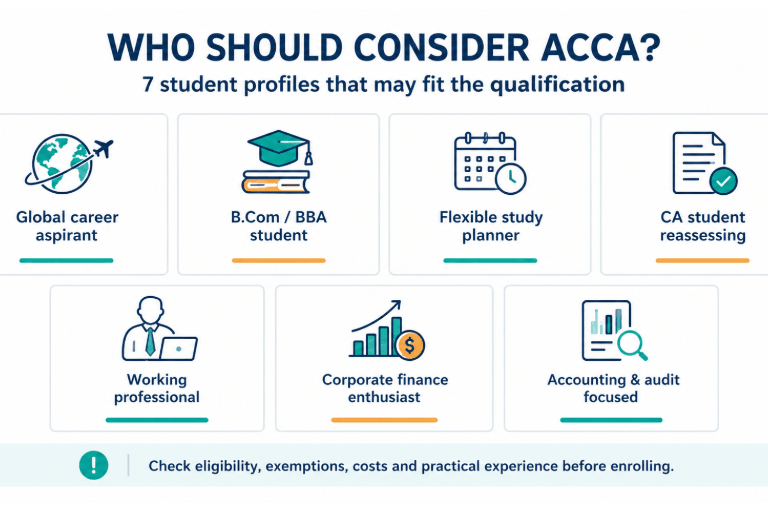
ACCA Course Suitable for Whom? 7 Types of Students Who'll Actually Vibe with It.

Every commerce student mostly faces the same question...... Should I do CA or ACCA or something else? And honestly choosing a professional course can feel overwhelming. Everyone has an opinion. But here is the thing. The right course depends on the career you want and not the course everyone around you is choosing. The ACCA qualification is a popular option for students interested in accounting, finance, auditing and international business. However it isn't one perfect fit for everyone. So how do you know whether ACCA is right for you? Let's look at seven types of students who may benefit from the course along with further information.
Quick Snippets

ACCA Course Suitable for Whom? Explained by Finplan Edu

Key Takeaways - ACCA Course Suitable For Whom?

  • ACCA is for - Students interested in accounting, auditing, financial reporting and international finance careers.

  • Before enrolling - Check eligibility, possible exemptions, total course costs and the career path you want to pursue.

  • B.Com and BBA students - You may qualify for exemptions depending on your degree and institution.

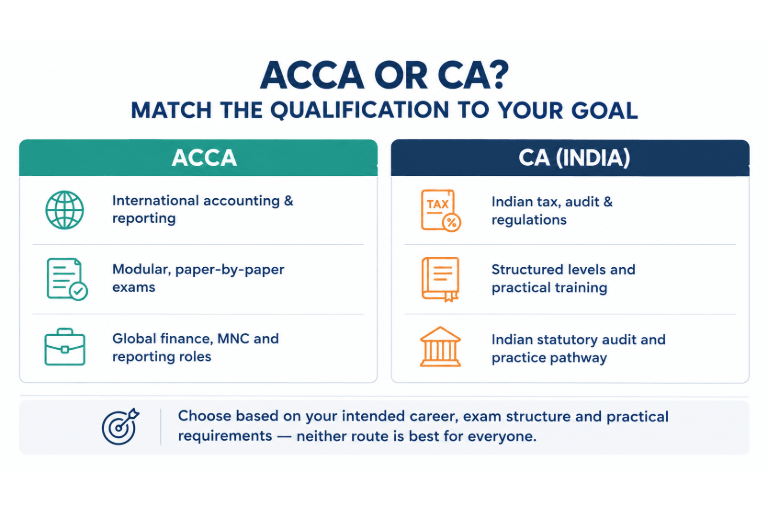
  • ACCA vs CA - ACCA focuses on international accounting, while Indian CA is particularly relevant for Indian taxation, statutory audits and independent practice.

Who Should Do ACCA Course

ACCA is basically the Association of Chartered Certified Accountants. It is a professional accountancy qualification awarded by a UK based global professional body.

The course is all about financial reporting, taxation, auditing as well as performance management and strategic business leadership. It helps students develop skills that employers need across accounting and finance teams.

The ACCA course is very much suitable for students who

  • Want to build a career in international accounting, financial reporting or audit

  • Prefer clearing exams paper by paper instead of preparing for several subjects together

  • Are interested in working with multinational companies and global finance teams

  • Want to study alongside college, internships or a full time job

  • Enjoy understanding how businesses manage money and make financial decisions

The qualification has eligibility requirements, examination fees and practical experience requirements. Understanding these before enrolling can help you make a better decision.

ACCA Student Profiles

For The Student Who Wants To Build An International Career

Imagine working with a finance team that prepares reports for clients across different countries. Or helping a multinational company understand its financial performance across several markets.

If that sounds like something great for you ACCA could be worth exploring.

The qualification has international recognition and focuses on accounting and financial reporting practices used across global businesses. This can be useful if you want to explore opportunities in India or overseas.

However international recognition doesn't automatically guarantee you one job or work visa. Employers also consider your practical skills, experience, communication and the requirements of the country where you want to work.

ACCA may suit you if you're more into

  • International financial reporting and accounting

  • Audit and assurance opportunities with global firms

  • Finance positions in multinational companies

  • Accounting and reporting teams serving overseas clients

  • Building a career that could offer international mobility over time

You can also pursue ACCA while living in India. Many international businesses have finance and accounting teams in Indian cities so you don't necessarily need to move abroad to use the qualification.


Commerce Students Who Find The Traditional CA Route Challenging

CA and ACCA are both respected professional qualifications but they serve different career goals.

The Indian CA qualification has a strong focus on accounting, auditing, taxation and Indian regulatory requirements. ACCA offers a broader international accounting perspective including financial reporting and strategic business management.

The difference isn't simply that one course is easier than the other. Their exam structures, subject coverage, practical requirements and career applications differ.

For some students the ability to prepare for individual ACCA papers makes the journey easier to organise around their other commitments. However the syllabus is demanding and passing still requires consistent preparation.

Here's a quick comparison of ACCA vs CA India.

Factor

ACCA

CA (India)

Main focus

International accounting and finance

Accounting, audit, taxation and Indian regulations

Exam structure

Individual papers across different levels

Foundation, Intermediate and Final routes subject to applicable exemptions

Career direction

Global finance, reporting, audit and accounting

Indian practice, audit, tax and corporate finance

Study flexibility

Multiple exam sessions and paper by paper progression

Structured examination and practical training requirements

Best suited for

Students seeking international accounting exposure

Students targeting Indian CA practice and related careers

Choose ACCA if its subjects and career pathways match your interests. Choose CA if you want to specialise in Indian taxation, statutory audit, or independent practice.


B.Com And BBA Students Who Don't Want To Start From Zero

Already pursuing a B.Com or BBA? You may have an advantage when preparing for ACCA.

Your degree may have introduced you to subjects such as accounting, economics, business law and financial management. These concepts can provide a useful foundation for your professional studies.

You may also qualify for ACCA exemptions based on your previous education. The number of exemptions depends on your institution, programme, subjects and the applicable ACCA exemption rules.

Here's what B.Com And BBA students should know before planning.

Your Background

What It Means For ACCA

Class 12 student

You may qualify through the applicable minimum entry requirements

B.Com student

You can check whether your programme offers exemptions for eligible papers

BBA student

Exemptions may be available depending on your degree and subjects

Graduate

Your completed degree may qualify you for exemptions, subject to assessment

CA student or part qualified candidate

Previous qualifications and completed examinations may affect your exemption eligibility


Exemptions can save preparation time but they aren't automatic for every graduate. Check your exact qualification through ACCA's official exemption resources before budgeting for the course.

Also don't skip a paper just because you're eligible for an exemption. If you have limited knowledge of the subject, learning the fundamentals can help you with later papers.

Students Who Left CA Midway And Working Professionals Who Need Flexibility

Leaving CA midway doesn't mean you have failed at building a finance career. It's okay to reassess your plans.

ACCA could be an alternative if you still enjoy accounting and finance but prefer a different examination structure or want to pursue internationally focused roles.

Your previous CA progress may also make you eligible for certain exemptions. However these depend on the examinations you have passed and ACCA's current rules.

Before switching compare the remaining requirements, fees and career outcomes rather than making a decision based only on frustration.

The same flexibility can benefit working professionals.

If you're already employed you may be able to prepare for ACCA alongside your job. The examination schedule offers multiple opportunities during the year although the availability of individual papers varies by level and session.

A practical approach is to

  • Set aside fixed study hours each week instead of waiting for free time

  • Choose a realistic number of papers based on your work commitments

  • Review the total examination and tuition costs before registering

  • Use mock exams to identify weak areas before the actual examination

  • Check your exemption eligibility before deciding which papers to prepare for.

ACCA or CA Qualification Comparison

Students Who Enjoy Business Strategy And Want Corporate Finance Careers

Some students enjoy accounting entries. Others want to understand why a company is expanding or how it manages financial risk or what its financial statements reveal about its future.

If you are curious about these bigger business questions ACCA may interest you.

The qualification covers more than basic bookkeeping. Its subjects include financial management along with performance management, strategic business leadership and financial reporting.

These areas can help you understand how financial information supports business decisions.

ACCA may also be relevant if you are targeting multinational companies or Global Capability Centres (GCCs) and large professional services firms.

Based on skills and experience job paths include 

  • Financial accountant - Helps prepare and maintain accurate financial records and reports

  • Financial reporting analyst - Supports reporting processes and analyses financial information

  • Audit associate - Assists with examining financial records, controls, and compliance 

  • Management accountant - Helps teams understand costs, budgets, and business performance

  • Finance analyst - Uses financial data to support planning and business decisions 

These are possible career directions and not guaranteed outcomes. 

And you should also understand the limits of the qualification in India. ACCA alone does not grant the statutory audit signing rights reserved for eligible practising members of ICAI under Indian law.

If you want to build a corporate finance career that distinction may not be a problem. If your goal is to establish an independent CA practice in India you should examine the CA route carefully before choosing.


Who ACCA Is Probably Not For

ACCA can be valuable but it isn't the right choice for every student.

Being honest about its limitations is just as important as understanding its benefits. A qualification makes sense when its costs, study requirements and career opportunities align with your plans.

You may want to reconsider ACCA if:

  • You want to specialise in Indian statutory auditing. The Indian CA qualification is the more relevant route for statutory audit signing rights

  • You aren't interested in accounting or finance. A professional qualification won't feel worthwhile if you dislike the work it prepares you for

  • You're expecting a guaranteed high salary. No qualification can promise a specific package, promotion, or job placement

  • You haven't considered the total cost. Examination fees, tuition, study materials, and possible retakes can add up

  • You struggle to study independently. ACCA requires regular preparation, even if you enrol in coaching classes

  • You want a qualification without practical experience. Earning the ACCA membership requires meeting its applicable practical experience and other membership requirements

Before making your decision ask yourself three questions

  1. Do I actually enjoy finance and accounting?

  2. Do the jobs I want require or value this qualification?

  3. Can I realistically manage the cost and study schedule?

If you can answer these questions clearly you'll be in a much better position to decide whether ACCA is worth pursuing.


Frequently Asked Questions

1. Can I do ACCA after 12th commerce?

Yes you can begin ACCA after Class 12 if you meet the applicable entry requirements. Your eligibility is all based on your academic qualifications and required minimum subject and marks criteria. Check the current ACCA entry requirements before registering.

2. Is ACCA harder or easier than CA?

Neither qualification is automatically easier for everyone. ACCA focuses on international accounting while Indian CA covers Indian taxation, auditing and regulations. Your strengths, study habits and career goals will influence which course suits you better.

3. Will i get a job in India with just ACCA?

ACCA can help you apply for accounting, audit, financial reporting, and finance roles in India. However, employment isn't guaranteed. Employers also value practical experience, Excel skills, communication, and relevant technical knowledge.

4. Is ACCA good for average students?

Yes ACCA can suit students with different academic backgrounds. Consistent preparation, regular practice and a willingness to learn difficult concepts matter more than being a topper. Choose a realistic study pace and focus on steady improvement.

5. Is English required for ACCA in India?

Yes, ACCA examinations are conducted in English. You don't need perfect English but you should understand technical terms and read questions carefully and explain your answers clearly. Regular reading and writing practice can help build confidence.

6. Can I switch from CA to ACCA later?

Yes you can switch from CA to ACCA. Depending on your completed examinations and qualifications you may be eligible for exemptions. Check ACCA's exemption rules and compare the remaining costs before making the switch.

7. How long does it take to complete ACCA?

Completion time depends on your exemptions as well as exam progress and study schedule. You must also meet the applicable practical experience and membership requirements. Plan your timeline around your commitments rather than relying on a fixed completion promise.

8. Is ACCA worth it for students in India?

ACCA may be worthwhile if you're targeting international accounting or financial reporting, audit or corporate finance roles. Its value depends on your career goals, course costs and practical experience. Compare it with CA before deciding.

If you want to explore options….

Choosing the right professional course becomes easier when you understand the eligibility requirements, examination structure, fees and career opportunities before enrolling.

Take the time to compare your options, assess your interests, and create a study plan that fits your goals.

If ACCA sounds like the right direction for you then start by exploring our ACCA course details and eligibility requirements to understand your next steps.

Questions about courses or classes?
Email enquiries@finplanindia.com, call 9029007248, or find us on Google Maps.

Who we are: Finplan Edu is a finance education institute in India. We help students earn globally recognised certifications and integrated degrees.

What you can study: Our certifications include ACCA, US CMA, ICWIM, the CFMA + iBCom Pathway and a PG Certificate in Investment Banking & Wealth Management. If you want a degree alongside your certification, you can choose B.Com International + ACCA, M.Com International + ACCA or the PGDM in International Accounting & Finance with ACCA.

Our partners: We deliver these degree programs with SIES College, Lala Lajpatrai College, Smt. CHM College, Hinduja College, Joshi Bedekar College, KES BK Shroff College, Jhunjhunwala College, Auro University and Gyan Vihar University.

Where you can learn: We run online and offline classes in Mumbai and Thane. Students in Chennai, Pune, Delhi, Bangalore, Hyderabad, Jaipur, Kerala, Ahmedabad and Kolkata can join online. We also have an Authorised Learning Center in Surat.

Visit us: Finplan Edu Head Office, 2nd Floor, Silver Castle, Majiwada Road, next to Radhakrishna House, Sainath Nagar, Majiwada, Thane, Maharashtra 400601.

Have questions? Contact us