
Your Global Finance Career is Loading…

IFRS vs Ind AS: Key Differences Every Finance Professional Should Know

IFRS is the global accounting language used in more than 140 countries. Ind AS is India's version of it. The two share the same core ideas, such as fair value, control-based consolidation and principles-based judgment. They differ where Indian law, Indian markets or Indian policy needed something different. This guide explains who issues each, where they split, who must follow Ind AS, and how this knowledge helps your career. If you have studied ACCA or worked in an Indian company, you have probably asked a simple question. Is Ind AS just IFRS with a different name? The short answer is no, but it is close.Many students memorize a list of differences and still get confused in exams and interviews. That happens because most of the list is about similarities. The real differences are fewer and easier to remember once you see why they exist. This article walks you through both, in plain language.  
Quick Snippets

Key Differences Between IFRS and Ind AS by Finplan Edu

What Is IFRS and What Is Ind AS?

IFRS stands for International Financial Reporting Standards. The International Accounting Standards Board (IASB), which sits under the IFRS Foundation, issues them. Older standards still carry the name IAS, such as IAS 19 on employee benefits. Together they are often called IFRS Accounting Standards. Many countries require them for listed companies, and others allow them.

Ind AS stands for Indian Accounting Standards. They follow the IFRS structure and use matching numbers in many cases, for example Ind AS 12 for income taxes. They apply to Indian companies under the Companies (Indian Accounting Standards) Rules, 2015. India chose to converge with IFRS instead of adopting it as issued. That choice is the source of every difference in this article.

Why Does the Difference Matter?

If you are a student, exam questions often test the gap between the two. If you are a working accountant, the gap changes real numbers in the balance sheet and profit and loss account. A company that holds a rented building, merges two group entities or runs a pension plan can report different results under each framework.
Employers care too. Indian companies with foreign parents, global capability centres and Big 4 audit teams often work with both frameworks in the same week. A person who can explain the difference quickly is useful on day one.

Key Differences Between IFRS and Ind AS

Who issues them and what makes them law

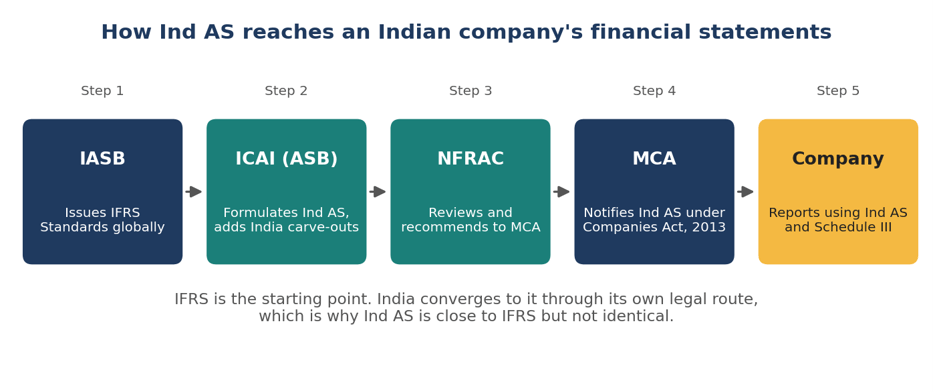
The IASB writes IFRS, but IFRS has no legal force by itself. Each country decides how to bring it in. In India, ICAI's Accounting Standards Board formulates Ind AS, the National Financial Reporting Authority (NFRAC) reviews them, and the Ministry of Corporate Affairs notifies them. That is why Ind AS is part of Indian company law and IFRS is not.

Presentation and disclosure

IFRS gives companies fairly wide freedom in how they lay out financial statements. Indian companies must also follow Schedule III of the Companies Act, 2013, which sets formats for the balance sheet, statement of profit and loss and notes. Indian law also asks for extra disclosures that IFRS does not require, so Ind AS reports are often longer.

A quick side-by-side

The table below covers the main areas people usually compare. Most rows show that the two are close, which is the point.

Area

IFRS

Ind AS

Issuer

IASB, under the IFRS Foundation

Formulated by ICAI's Accounting Standards Board, notified by the MCA

Legal status

Adopted through each country's own rules

Notified under the Companies Act, 2013

Conceptual framework

IFRS Conceptual Framework

Aligned with it, with some India-specific wording

Presentation

Flexible formats

Must follow Schedule III

Disclosures

Driven by materiality and judgment

Extra disclosures required by Indian law

First-time adoption

IFRS 1

Ind AS 101

Government grants

IAS 20

Ind AS 20, largely the same

Borrowing costs

IAS 23

Ind AS 23, largely the same

Employee benefits

IAS 19, corporate bond yields for discounting

Ind AS 19, government bond yields for discounting

Income taxes

IAS 12

Ind AS 12, same principles, Indian tax rules

Segment reporting

IFRS 8

Ind AS 108, largely the same

Sector guidance

Limited

Extra rules for sectors such as NBFCs and insurers


The differences that actually change numbers

These are the carve-outs. They are the ones worth learning properly, because they are where reported results can move.

Topic

IFRS

Ind AS

Investment property

IAS 40 lets you choose the cost model or the fair value model

Ind AS 40 allows the cost model only, with fair value disclosed

Mergers within the same group

IFRS 3 does not cover them, so companies pick a policy

Ind AS 103 requires the pooling of interests method at book values

Pension discount rate

High-quality corporate bond yields

Government bond yields

Foreign currency convertible bonds

Conversion option is usually a derivative liability

Ind AS 32 treats the option as equity in specified cases


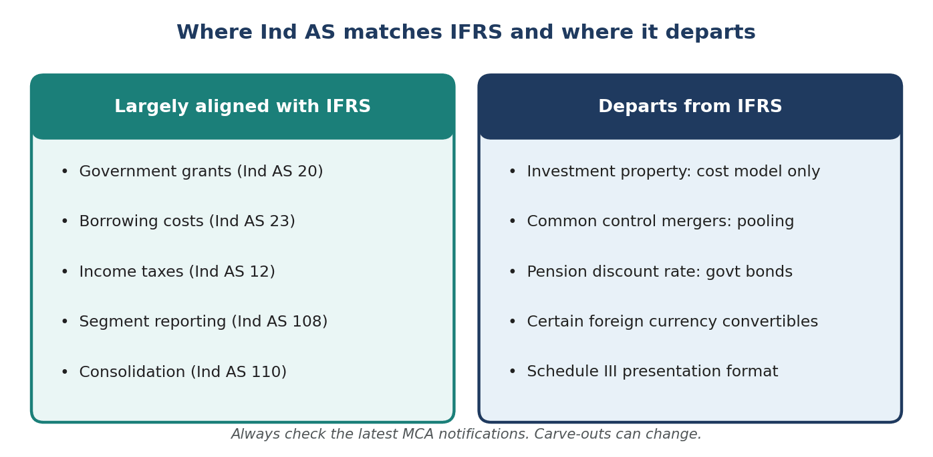
where Ind AS matches IFRS and where it departs

Figure 1: Where Ind AS matches IFRS and where it departs.

Who Has to Follow Ind AS?

Ind AS is not for every Indian company. Applicability depends on listing status and net worth, and the rules were brought in phase by phase starting in 2016. Companies outside those limits follow the older Indian Accounting Standards (AS). Check the current MCA rules before you apply this to a specific company.

In simple terms, here is how it usually works:

•    Listed companies above the prescribed net worth limits must use Ind AS.

•    Unlisted companies with net worth of Rs 250 crore or more are generally covered.

•    Holding, subsidiary, joint venture and associate companies of covered companies must also follow Ind AS.

•    Banks, insurers and NBFCs follow their own phased timelines.

•    Smaller companies, and companies listed on SME exchanges, mostly continue with AS.

IFRS applicability is different. It depends on the country. Some require it for all listed companies, some allow it, and some do not use it at all.

How Ind AS Is Created and How Companies Switch to It

Ind AS does not appear overnight. The standard starts as an IFRS, goes through ICAI, gets reviewed, and only becomes binding when the MCA notifies it. The flow below shows the route.


How Ind AS Is Created and How Companies Switch to It

Figure 2: The route from IFRS to Ind AS in an Indian company's accounts.


A company moving to Ind AS for the first time follows Ind AS 101, the counterpart of IFRS 1. The basic steps are simple to remember:

1.    Pick the transition date, which is the start of the earliest comparative period.

2.    Prepare an opening balance sheet on that date using Ind AS.

3.    Apply the standards retrospectively, using the exemptions Ind AS 101 allows.

4.    Reconcile equity and profit from the old Indian GAAP to Ind AS, and explain the gaps.

The reconciliation step is where most of the real work sits, because it shows investors exactly what changed and why.

Career Opportunities for Finance Professionals

Knowing both frameworks opens doors in audit, financial reporting, group consolidation, treasury and technical accounting. Big 4 firms, global capability centres, listed Indian companies and multinationals all need people who can move between the two. It also helps in roles that review deals, mergers and valuations, because framework choices affect how those deals are reported.

On the qualification side, the ACCA reporting papers are built on IFRS, and you can see the full path in the ACCA qualification structure. ACCA is run by a global body, and you can read more about it on the ACCA about us page. If management accounting interests you more, the CIMA professional qualification is another route that uses IFRS knowledge in practice.

If you want structured support, Finplan Edu offers ACCA coaching in Mumbai, the PGDM-IAF programme and US CMA training. Each one builds the reporting base that IFRS and Ind AS work depends on.

Comparison With Other Frameworks

IFRS and Ind AS are not the only options. Here is how they sit next to US GAAP and the older Indian AS, using the same criteria for each.

Criteria

IFRS

Ind AS

US GAAP

Issued by

IASB

ICAI formulates, MCA notifies

FASB

Where used

Over 140 jurisdictions

Indian companies above set limits

United States

Style

Principles-based

Principles-based, with carve-outs

More detailed rules

LIFO inventory

Not allowed

Not allowed

Allowed

Best to learn for

Global roles, ACCA

Indian reporting and audit

US listings, US CMA and CPA paths


Older Indian AS still apply to companies below the Ind AS limits. They are simpler, and they are closer to earlier IFRS than to the current standards.

Practical Examples

Investment property

A company owns an office tower and rents it out. Under IFRS, it can choose the fair value model and report gains or losses in profit. Under Ind AS 40, it must use the cost model and only disclose fair value. Two otherwise identical companies can show different profits in the same year.

A merger inside a group

Two subsidiaries of the same parent merge. IFRS 3 does not deal with this, so a company reports using a chosen policy, often predecessor accounting. Ind AS 103 sets one answer: pooling of interests. Assets move at book value, no goodwill appears, and comparatives are restated as if the companies had always been together.

Discounting a pension obligation

An employer needs a discount rate to value gratuity and pension liabilities. IAS 19 points to high-quality corporate bond yields. Ind AS 19 points to government bond yields. A different rate means a different liability, even when the employees and the promises are identical.


Common Mistakes

Most errors come from treating the two frameworks as either identical or completely separate. These are the ones we see most often.

•    Assuming Ind AS is a copy of IFRS and skipping the carve-outs.

•    Forgetting that Schedule III controls the format of Indian financial statements.

•    Saying ICAI issues Ind AS on its own. ICAI formulates them, and the MCA notifies them.

•    Mixing up standard numbers, for example IFRS 8 and Ind AS 108.

•    Using an old article. Notifications and amendments change, so always check the latest MCA position.

•    Ignoring the exemptions in Ind AS 101 when planning a first-time switch.

Frequently Asked Questions

What is the difference between IFRS and Ind AS?

IFRS is the international framework issued by the IASB. Ind AS is India's converged version, formulated by ICAI and notified by the MCA. They share core principles, but Ind AS has carve-outs and extra Indian requirements such as Schedule III.

Is Ind AS the same as IFRS?

No. It is substantially converged with IFRS, but not identical. Investment property, common control mergers and the pension discount rate are well-known differences.

Who issues IFRS and Ind AS?

The IASB issues IFRS. ICAI's Accounting Standards Board formulates Ind AS, and the Ministry of Corporate Affairs notifies it under the Companies Act, 2013.

Why does India use Ind AS instead of IFRS as it is?

Indian law, markets and regulation needed some changes. India chose convergence so it could keep control over the standards while staying close to global practice.

What is the difference between IFRS 1 and Ind AS 101?

Both govern first-time adoption. IFRS 1 applies when a company first adopts IFRS, and Ind AS 101 applies when an Indian company first moves to Ind AS.

Does Ind AS apply to every Indian company?

No. It applies based on listing status and net worth, along with group relationships. Smaller companies mostly continue with the older AS.

Is the ACCA syllabus based on IFRS or Ind AS?

ACCA's reporting papers are based on IFRS. If you plan to work in India, learn the main Ind AS differences too.

How should I study IFRS and Ind AS together?

Learn IFRS first. Then study Ind AS as a list of carve-outs and extra requirements, and practise with short examples like the ones above.


Conclusion

Ind AS is IFRS adjusted for Indian law and practice. Most standards read the same, and a handful of carve-outs create the real gaps. Learn those carve-outs, understand Schedule III, and you will handle most exam and workplace questions with confidence.
If you want a clear learning path from here, speak to the Finplan edu team or email enquiries@finplanindia.com. Explore ACCA coaching at Finplan edu and build the reporting skills that employers look for.

Have questions? Contact us