Your Global Finance Career is Loading…

ESG and Sustainability Reporting Careers for Accounting Students In Finance

The finance industry is changing. Companies do not judge only by their profits and financial performance. Investors also want to understand how businesses treat employees, manage environmental impact and follow ethical practices. This is where ESG comes in. ESG is nothing but Environmental Social and Governance. It helps companies measure and report their performance beyond traditional financial figures. For accounting students and professionals this change creates new career opportunities. Companies need people who understand financial reporting, auditing, compliance and sustainability disclosures. If you are pursuing ACCA or US CMA or even a commerce degree learning about ESG could help you find another area of finance. But what does an ESG career involve and what should you learn to enter this field? Let's take a closer look.

Quick Snippets

ESG and Sustainability Reporting Careers for Accountants

Key Takeaways

●       Environmental, Social and Governance is meant to measure responsible business practices.

●       Accountants can work in sustainability reporting, ESG compliance, auditing and risk assessment.

●       BRSR reporting in India and IFRS S1 and IFRS S2 are important frameworks to understand.

●       ESG careers require accounting knowledge, data analysis and reporting skills.

●       ACCA and US CMA provide useful finance foundations that can be developed with specialised ESG learning.

What Is ESG And Why Does It Matter In Finance

The meaning of ESG becomes easier to understand when you look at how businesses operate. A company may earn strong profits but still face problems because of pollution or poor employee treatment or weak corporate governance.

ESG helps investors and stakeholders examine these factors. It provides a way to understand how responsibly a company operates and manages its business risks.

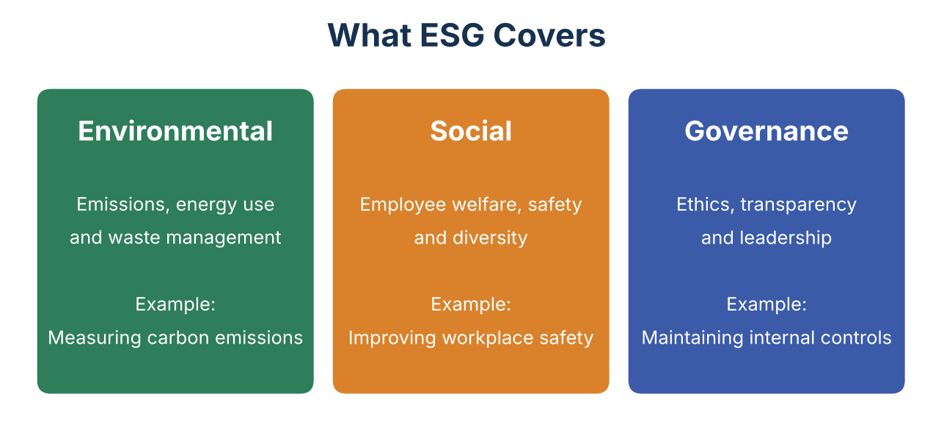
The three elements of ESG cover different areas of business performance:

ESG Factor

What It Covers

Example

Environmental

Emissions as well as energy and waste management

Measuring carbon emissions

Social

Employee welfare along with safety and diversity

Improving workplace safety

Governance

Ethics and transparency and leadership

Maintaining internal controls

Why Is ESG Important For Accountants

Accountants already work with financial information, audits, internal controls and compliance. These skills are useful when companies collect and report sustainability information.

What ESG Covers

Why Is ESG Creating Career Opportunities For Accountants

Companies face increasing pressure to explain their environmental and social impact. Investors want information about climate risks, employee practices and business ethics before making investment decisions.

Regulatory reporting requirements have also increased the importance of sustainability information. In India SEBI introduced the BRSR (Business Responsibility and Sustainability Report) framework for applicable listed organizations.

This creates opportunities for accounting professionals who can collect, analyse and verify business information.

Accountants can contribute to this process through:

●       Sustainability reporting - Preparing and reviewing information about environmental and social performance.

●       ESG compliance - Checking whether disclosures follow applicable reporting requirements.

●       Risk assessment - Identifying financial risks linked to climate change and resource shortages.

●       Internal audit - Reviewing ESG data, documentation and reporting controls.

●       Corporate governance - Supporting transparency, accountability and ethical business practices.

Which ESG Reporting Frameworks Should Accountants Know

Before exploring sustainability reporting jobs understand the frameworks companies use to disclose ESG information. These frameworks provide structure and help organisations report information consistently.

Business Responsibility and Sustainability Reporting In India

BRSR reporting is one framework introduced by the SEBI (Securities and Exchange Board of India). It requires applicable listed companies to disclose information about their performance across nine principles of responsible business conduct.

BRSR covers environmental performance, employee welfare, business ethics and governance practices. BRSR Core focuses on selected ESG indicators that support more structured reporting and assessment.

IFRS S1 And IFRS S2 Standards

The ISSB (International Sustainability Standards Board) issued both standards in June 2023. IFRS S1 is all about general sustainability related financial disclosures and IFRS S2 is specifically about on climate related risks and opportunities.

Both standards are effective for annual reporting periods beginning on or after 1 January 2024 subject to adoption in the relevant jurisdiction.

Framework

Main Focus

BRSR

Sustainability disclosures by applicable Indian listed companies

BRSR Core

Selected ESG performance indicators

IFRS S1

General sustainability-related financial risks and opportunities

IFRS S2

Climate-related financial disclosures

GRI Standards

Impacts on the economy and environment and people

What All Career Opportunities Are Available In ESG

ESG reporting has created opportunities across consulting firms, banks, investment organisations and corporate finance departments. The work is not limited to environmental specialists because accounting professionals can contribute through reporting, auditing and data analysis.

Some common ESG accounting roles include:

Job Role

Responsibility Covered

ESG Analyst

Analyses ESG data, performance and business risks

Sustainability Reporting Associate

Help prepare sustainability disclosures

ESG Consultant

Advises companies on ESG practices and reporting

ESG Compliance Analyst

Reviews reporting requirements and compliance

Sustainability Assurance Associate

Supports verification of sustainability information

Consulting and audit firms may help clients prepare reports and review disclosures. Banks and investment firms may examine ESG information while assessing business risks and investment opportunities.

Large companies may also have dedicated sustainability teams. Entry level candidates can explore ESG research, reporting support, audit assistance and data analysis positions.

Job titles and eligibility requirements vary between employers so review job descriptions before choosing a career path.

What Skills Do You Need To Build An ESG Career

An accounting qualification provides a useful foundation, but ESG roles require additional knowledge. You need to understand how sustainability information is collected, measured and presented.

Focus on developing these ESG analyst skills:

●       Financial reporting - Know more about financial statements along with reporting principles and business performance

●       Data analysis - Learn Excel and practice analysing information such as energy consumption and emissions

●       ESG frameworks - Understand BRSR as well as IFRS S1 and IFRS S2 and their disclosure requirements

●       Audit and compliance - Learn to check supporting documents, identify inconsistencies and maintain accurate records

●       Communication - Develop the ability to explain findings and work with finance, operations and management teams

You can develop these skills while studying ACCA or US CMA. Accounting and audit knowledge helps with reporting controls while management accounting helps you understand costs and business performance.

Start with Excel and financial reporting. Then practice analysing a company's publicly available sustainability report to understand how these skills are used in actual business reporting.

Which ESG Certifications And Qualifications Should You Consider

If you want to enter ESG you may wonder whether you need a separate certification. The answer depends on your existing qualifications and the type of job you want.

ACCA and US CMA provide relevant accounting and finance knowledge. However, neither qualification alone guarantees an ESG job or specialist sustainability expertise.

Qualification

Main Learning Area

Career Relevance

ACCA

Financial reporting, audit and governance

Supports ESG reporting and assurance related work

US CMA

Management accounting and performance analysis

Connect sustainability measures with business performance

ESG awareness programmes

ESG concepts and responsible business

Introducing sustainability fundamentals

IFRS Sustainability learning

IFRS S1 and IFRS S2

Develops international reporting knowledge

GRI learning

Sustainability reporting

Builds knowledge of broader ESG disclosures

Does ACCA Help You Build An ESG Career

Yes. ACCA covers areas such as financial reporting, auditing, risk management and corporate governance which are relevant to ESG responsibilities.

ACCA also provides ESG awareness resources to help finance professionals understand sustainability and its importance in business. US CMA students can similarly benefit from learning how sustainability measures influence budgeting, cost management and performance evaluation.

Before choosing an ESG certification review its syllabus, practical assignments, recognition and cost. Select a programme that supports your career goals rather than collecting certificates without a clear learning plan.

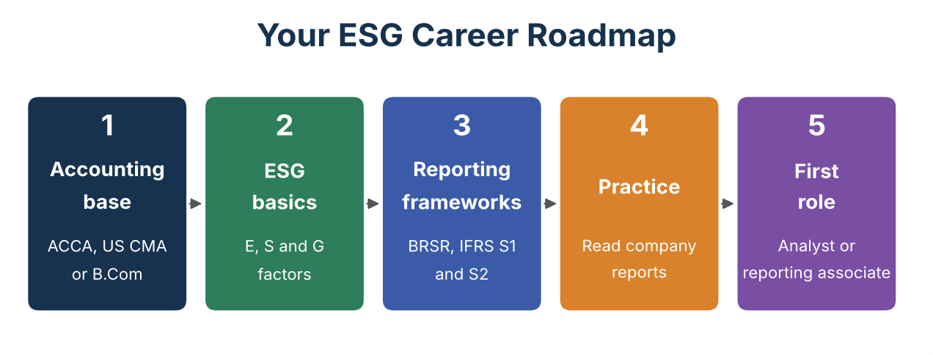
How To Start An ESG Career In Finance

If you are a commerce student or ACCA student or working accountant you can begin learning about ESG without changing your entire career plan. The best approach is to strengthen your accounting foundation and gradually add sustainability reporting knowledge.

Follow these steps to organise your preparation:

●       Understand ESG basics - Learn about environmental, social and governance factors and why companies disclose this information

●       Study reporting frameworks - Start with BRSR reporting in India and get to know more about IFRS S1 and IFRS S2

●       Strengthening accounting skills - Develop your knowledge of financial statements, auditing, internal controls and compliance

●       Practice with company reports - Study a listed company's annual report and BRSR disclosures to understand how ESG information is presented

●       Explore certifications - Compare relevant ESG courses based on their syllabus, practical training and learning objectives

You should also review job descriptions for ESG analysts, sustainability reporting and compliance positions. Note the qualifications and technical skills employers mention repeatedly.

An ESG career may suit you if you enjoy accounting, research, reporting and understanding how businesses operate. You do not need to become an expert overnight but consistent learning and practical experience can help you prepare for this field.

Your ESG Career in Finance

ESG Careers in Finance: Your Questions Answered

1. What does ESG stand for?

ESG stands for Environmental, Social and Governance. It refers to three areas used to assess how responsibly a company operates including its environmental impact on the treatment of people and governance practices.

2. Is ESG a good career option for accounting students?

A big yes. Accounting students can explore ESG roles because financial reporting, auditing and compliance knowledge are relevant to sustainability disclosures. Additional ESG training can help develop specialised skills.

3. What is BRSR reporting in India?

BRSR stands for Business Responsibility and Sustainability Reporting. It is a SEBI framework that requires applicable listed companies to disclose information about their environmental, social and governance performance.

4. What are IFRS S1 and IFRS S2?

IFRS S1 is more about general sustainability related financial disclosures and IFRS S2 is about climate related disclosures. Both standards were issued by the ISSB in June 2023.

5. Can ACCA students pursue ESG careers?

Yes. ACCA students can explore ESG roles because their studies develop accounting, financial reporting, audit and governance knowledge. Learning sustainability frameworks can help them build additional relevant skills.

6. What skills are required for an ESG analyst?

An ESG analyst needs data analysis, research, reporting, communication and attention to detail. Knowledge of accounting, sustainability frameworks and compliance is also useful.

7. Do I need to hold an ESG certification to have an ESG job?

Not every ESG position requires a separate certification. Employers may consider your qualifications, practical experience and knowledge of reporting frameworks. A relevant certification can support your learning but does not guarantee employment.

Your Next Google Search Should Be About Finplan Edu…

The finance industry is expanding beyond traditional accounting responsibilities. Understanding ESG can help you explore how financial knowledge connects with sustainability, governance and business performance.
Finplan Edu offers globally recognised finance qualifications and integrated degree programmes including ACCA and US CMA. With online and offline learning options, students and working professionals can build their finance knowledge while preparing for changing industry requirements. Have questions? Email us, call us or find us on Google Maps to talk it through.
Know more about Finplan Edu’s Finance and Accounting Courses to find a learning pathway that supports your career goals.

Have questions? Contact us