
Your Global Finance Career is Loading…

CPA or ACCA for Indian Students: Which Fits Your Career Plans?

Choosing between ACCA and US CPA is one of the most common questions graduates and working professionals ask us. Both are respected, both open real doors, and neither is better for everyone. Here is how they compare.
Quick Snippets

What Are ACCA and US CPA?

What Are ACCA and US CPA?

ACCA stands for the Association of Chartered Certified Accountants, a professional body based in the UK. Its qualification covers accounting, IFRS reporting, audit, corporate finance and compliance, and you can see the full structure on the ACCA Global qualification page. US CPA stands for Certified Public Accountant and is awarded through the AICPA with individual US state boards. It focuses on US GAAP, US auditing standards and US taxation. So ACCA is a broad business and finance qualification, while CPA is a licence built around US accounting work. If you want to see how ACCA is taught in India, the Finplan Edu ACCA course is a good place to start. Here is a quick snapshot.

•    Origin: ACCA comes from the UK and CPA comes from the US, and that shapes which standards each one teaches.

•    Standards: ACCA leans on IFRS, which most countries use, while CPA follows US GAAP and US tax law.

•    Exams: ACCA has 13 exams across three levels, while CPA has four sections that you must pass within one window.

•    Reach: ACCA is recognised in 180+ countries, while CPA carries most weight in the US and US-linked companies.

•    Fit: ACCA suits wider global finance roles, while CPA suits US-focused accounting and compliance work.

Exam Structure and Pattern Compared

ACCA has 13 exams split into Applied Knowledge, Applied Skills and Strategic Professional levels. The early exams are mostly objective-test questions, and descriptive questions start from the Applied Skills level. The pass mark is 50% for every paper. Applied Knowledge exams can be taken on demand, and most others run in March, June, September and December sessions. US CPA has four sections: three core sections (AUD, FAR and REG) and one discipline you choose from BAR, ISC or TCP. Older guides mention a BEC section, but that was replaced in 2024. Every section mixes multiple-choice questions with task-based simulations, and you need a scaled score of 75 to pass. The table below puts the two side by side.

Feature

ACCA

US CPA

Total exams

13 exams across 3 levels

3 core sections plus 1 discipline

Pass mark

50% per paper

Scaled score of 75

Question style

Objective tests, then descriptive questions

MCQs and task-based simulations

Exam timing

Sessions in Mar, Jun, Sep, Dec; some on demand

Core year-round; disciplines quarterly

Main standards

IFRS

US GAAP, US tax and auditing

Eligibility for Graduates and Working Professionals

ACCA is flexible about when you start. Most Indian students begin after Class 12, but graduates, working professionals and people holding qualifications like CA or an MBA can join too. ACCA also grants exemptions for prior study, up to a maximum of nine exams. Students in degrees like B.Com at certain universities can often claim around five, and a CA can claim far more. If you want a degree and ACCA together, look at B.Com International + ACCA at Finplan Edu. US CPA works differently, because your Indian degree must go through a credit evaluation in the US. You need 120 credits to sit the exam and 150 to get the licence, and a three-year Indian degree usually carries only 90 to 120 credits. Many aspirants add an M.Com or similar study to close the gap.

•    Degree evaluation: Agencies such as NASBA, NIE or WES review your transcripts and tell you how many credits you hold.

•    State board rules: Each US state sets its own credit and licensing rules, so choose a board that suits your profile.

•    Credit count: Sitting the exam needs 120 credits, while the licence needs 150, so plan both numbers early.

•    Closing the gap: Extra credits can come from a master's degree such as M.Com or other credit-bearing courses.

•    ACCA comparison: ACCA checks your degree for exemptions instead, so you can usually start sooner with less paperwork.

Duration, Cost and Work Experience

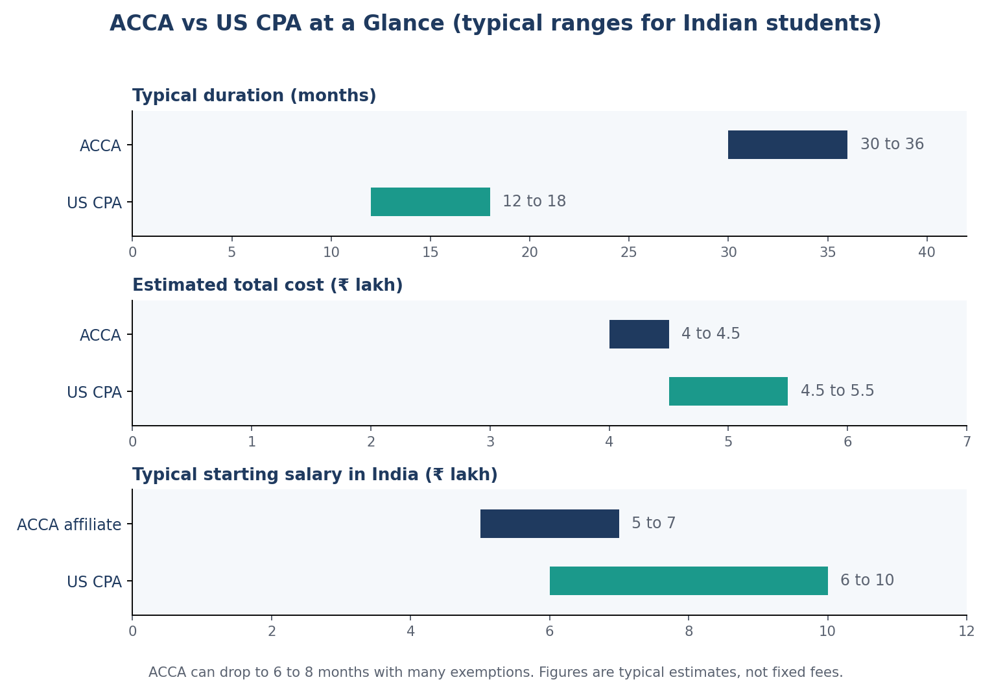
Most Indian students finish ACCA in about two and a half to three years. With exemptions, a Chartered Accountant can finish in as little as six to eight months. US CPA usually takes 12 to 18 months because there are only four sections. The total ACCA spend, including registration, exam fees, subscriptions and coaching, is often quoted at ₹4 to ₹4.5 lakh. For CPA, exam fees, credit evaluation and coaching together usually come to ₹4.5 to ₹5.5 lakh. These are typical estimates, so check current fees with ACCA, NASBA and your state board. Work experience also differs, because ACCA needs three years of relevant experience while CPA needs one to two years under a licensed CPA, depending on the state.

Factor

ACCA

US CPA

Typical duration

2.5 to 3 years; 6 to 8 months with many exemptions

12 to 18 months

Estimated total cost

₹4 to ₹4.5 lakh

₹4.5 to ₹5.5 lakh

Work experience

3 years, before, during or after exams

1 to 2 years under a licensed CPA, after exams


Typical duration for ACCA and US CPA, cost and starting salary ranges for Indian students.

Typical duration, cost and starting salary ranges for Indian students.

Career Scope and Salary in India

ACCA trains you across accounting, business and finance, so the job options are wide. You can work in reporting, IFRS, audit, risk, ESG and consulting, and move into corporate finance or investment banking with experience. Many Indian companies hire ACCAs for global consulting and finance work, and the qualification travels well abroad. US CPA is narrower but deep, and it fits US back-office and compliance roles in India or overseas. As an ACCA affiliate in India, you can expect a starting range of roughly ₹5 to ₹7 lakh. Full ACCA members often reach ₹8 to ₹10 lakh or more, while CPAs working in India usually earn about ₹6 to ₹10 lakh. These are typical figures, and your pay depends on city, employer and experience.

•    ACCA reporting and IFRS: Prepare financial statements for multinationals and Indian firms that follow international standards.

•    ACCA audit, risk and ESG: Review controls, assess risk and support sustainability reporting as demand for these skills grows.

•    ACCA finance and consulting: Move into planning, advisory and investment banking after you build some experience.

•    CPA US GAAP and audit: Work on US financial reporting, SOX internal controls and audits in Big Four or US-linked teams.

•    CPA US taxation: Handle US tax returns and compliance work for American clients from India or abroad.

Flexibility, Recognition and Signing Authority

ACCA is the more flexible option for working professionals. You can sit one paper at a time, and exemptions reduce the load further. CPA is closer to a sprint, because you must pass all four sections inside a rolling window. That window is now 30 months under NASBA's recommendation, though it used to be 18 months, and your state board sets the final rule. On recognition, ACCA is accepted in 180+ countries, while CPA carries most weight in the US and in US-based multinational companies. Signing authority is the point students often miss. Neither qualification lets you sign statutory audit reports of Indian companies, because that right stays with Indian Chartered Accountants. A licensed CPA can sign audit reports for US companies and their subsidiaries, and ACCA members can hold signing authority in many IFRS countries, subject to local rules.

Area

ACCA

US CPA

Flexibility

One paper at a time, plus exemptions

Four sections inside a 30-month window

Global recognition

180+ countries

Mainly the US and US-linked firms

Signing in India

Not for Indian statutory audits

Not for Indian statutory audits

Signing abroad

Valid in many IFRS countries, subject to local rules

Valid for US companies and subsidiaries

Which One Fits You?

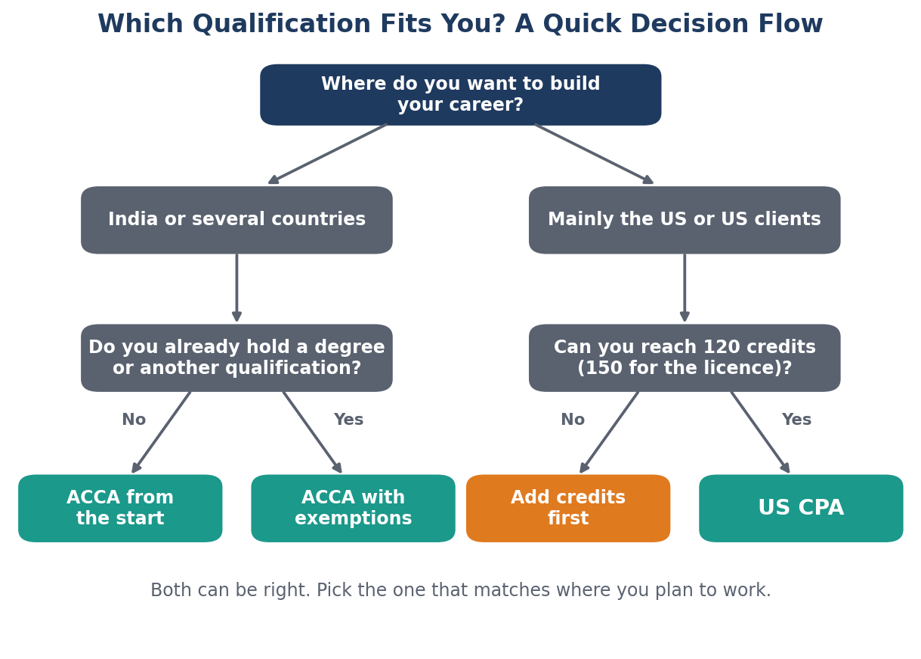
The better choice depends on where you want to work, not on which qualification sounds bigger. If your plan is to build a career in India or move across several countries, ACCA gives you the wider path. If you want to settle in the US or work in niche US accounting roles, CPA is the more direct route. Graduates with a B.Com or M.Com often find ACCA easier to start because of exemptions and fewer paperwork steps. Working professionals usually prefer ACCA too, since they can take one paper at a time around office hours. Some people eventually do both, but it makes sense to pick one first and build experience. Use the flow below and the checklist after it to test your own situation.


A quick decision flow for choosing between ACCA and US CPA.

A quick decision flow for choosing between ACCA and US CPA

•    Choose ACCA for wider reach: It is recognised in 180+ countries, so it suits careers in India and abroad.

•    Choose ACCA if you work full time: Studying one paper at a time fits around a busy schedule.

•    Choose CPA for a US career: It carries the licence that US roles and US clients expect.

•    Choose CPA if your credits are close: A degree near 120 credits keeps evaluation and extra study costs lower.

•    Talk to people who did each path: Real stories show what brochures leave out.

Frequently Asked Questions about ACCA vs CPA

Which is easier, ACCA or US CPA?

Neither is easy. ACCA has more exams but lets you study one paper at a time, while CPA has fewer sections but a tighter window and a higher scaled pass score.

Can I start ACCA after graduation?

Yes. Graduates can join and may receive exemptions based on their degree, up to nine exams. Many finish faster than students who start from the first paper.

How many credits do I need for CPA with an Indian degree?

You need 120 credits to sit the exam and 150 for the licence. Most three-year Indian degrees carry 90 to 120 credits, so many candidates add a master's degree or extra credits.

Can ACCA or CPA holders sign audit reports in India?

Not for statutory audits of Indian companies, which stay with Indian Chartered Accountants. Outside India, a licensed CPA can sign for US companies, and ACCA members can sign in many IFRS countries.

Which one pays more in India?

Typical ranges are ₹5 to ₹7 lakh for ACCA affiliates, ₹8 to ₹10 lakh or more for members, and ₹6 to ₹10 lakh for CPAs. Experience, city and employer move these numbers more than the qualification alone.

Can I study ACCA online?

Yes. ACCA online courses let you study from cities such as Mumbai, Pune, Hyderabad, Thane, Bangalore, Chennai, Delhi, Kolkata, Ahmedabad, Kerala and Surat without relocating.


Ready to Pick Your Path?

Still unsure which qualification fits your goals? Have a friendly, no-pressure chat with the team at Finplan Edu about ACCA and your next step. You can also write to enquiries@finplanindia.com or call 9029007248.

Have questions? Contact us