Your Global Finance Career is Loading…

Best Certification Course After MBA Finance to Improve Your Job Prospects

Completing an MBA Finance degree will give you a good perception of what financial management, accounting, investments and business decisions are. But when you start looking for jobs you may just find that many employers also expect some additional knowledge and practical skills. And only professional certifications can help you here. If you have completed your MBA Finance and are not sure what to study next this blog can help you. Come… let us find out some best certifications after MBA Finance along with their benefits and how to choose the right one.

Quick Snippets

Best Certification Course After MBA Finance for Better Jobs

Key Takeaways

  • Short courses can help MBA Finance graduates in developing practical skills in areas like financial modelling and investment banking.
  • Your career goals should guide your certification choice rather than the popularity of a qualification.
  • Professional certification can add more strength to your profile, but practical experience and communication skills are also equally important.

Why Should You Consider Certifications After MBA Finance

An MBA gives you a broad idea of finance, but it may not cover every technical skill required for specialised roles. 
A professional certification lets you focus on those gaps and gives you a structured way to learn subjects tied directly to your career interests.
It can help you show your knowledge when applying for jobs. Anyhow completing a certification does not automatically guarantee employment.
The real benefit comes when you combine what you learn with practical experience. Employers also look at your ability to analyse information, use financial tools and explain your findings.

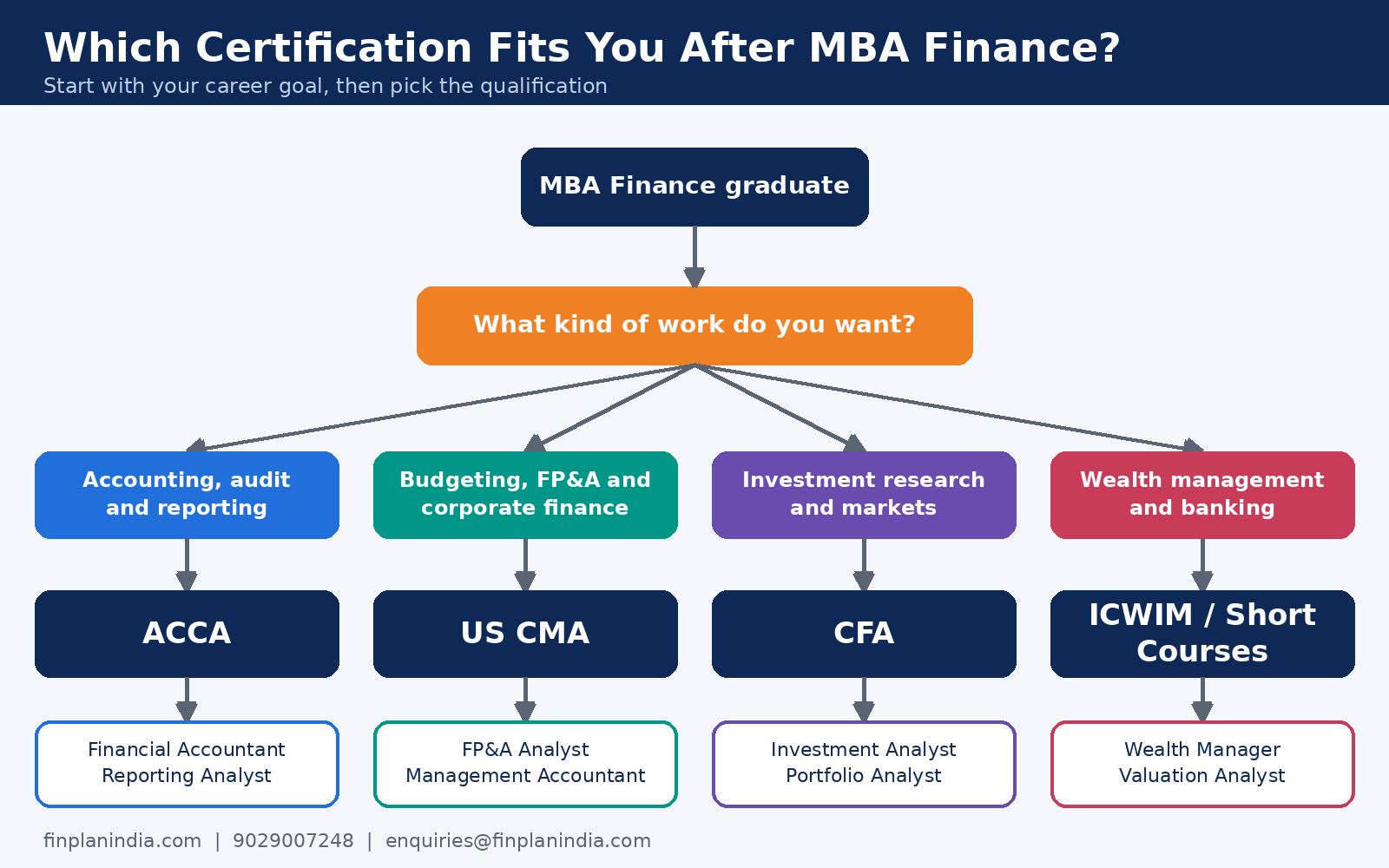
Here are some career areas you can consider after MBA Finance:

Career Area

Possible Job Roles

Relevant Qualification

Accounting and reporting

Financial Accountant, Reporting Analyst

ACCA

Management accounting

Cost Analyst, Management Accountant

US CMA

Investment management

Investment Analyst, Portfolio Analyst

CFA

Corporate finance

Financial Analyst, FP&A Analyst

US CMA, ACCA

Investment banking

Investment Banking Analyst, Valuation Analyst

CFA, Financial Modelling

Wealth management

Wealth Manager, Investment Advisor

ICWIM


5 Short Courses For MBA Finance Graduates

ACCA After MBA Finance - Is It A Good Pick

ACCA qualification is a good pick for MBA Finance graduates who want to develop their knowledge of accounting and financial management.

It can be useful if you want to collaborate with multinational companies, accounting firms or finance departments. It also offers opportunities in areas like financial reporting, internal audit and business finance.
One advantage of ACCA is its structured qualification pathway. It includes Applied Knowledge, Applied Skills and Strategic Professional examinations along with an Ethics and Professional Skills module and a practical experience requirement.

Your MBA may also make you eligible for certain ACCA exam exemptions. Anyhow exemptions depend on your previous qualification, institution and the subjects you have studied. You should check your eligibility through ACCA's official exemption calculator before registering.

Is ACCA And MBA A Great Combo?

A big yes very particularly if you want to build a career in accounting, financial reporting or corporate finance. Your MBA provides a bigger view of what business is while ACCA develops specialised accounting and finance knowledge.

US CMA After MBA - Who Should Choose It

US CMA is another useful option for MBA Finance graduates. It focuses on management accounting and financial management very particularly how financial information supports business decisions.

It’s not like a qualification focused mainly on external financial reporting. US CMA places considerable attention on internal business performance. It includes budgeting, forecasting, cost management, performance analysis and strategic financial management.
The qualification has two examination parts. Part 1 is about Financial Planning, Performance and Analytics while Part 2 is about Strategic Financial Management.
This makes it relevant for graduates interested in working with business budgets, financial forecasts and management reports. It can also help professionals prepare for responsibilities involving financial planning and analysis.

To earn the certification candidates need an eligible bachelor's degree or an accepted professional qualification, two continuous years of relevant professional experience and passes in both examination parts. You can finish the experience requirement within or even before 7 years of passing the exam.

You can pick US CMA if you enjoy understanding how companies manage their finances rather than focusing only on preparing financial statements. It can be a practical addition to an MBA when your career goals involve corporate finance, cost management or FP&A.

CFA After MBA Finance: Is It Worth

CFA programme is meant for people interested in investment analysis and portfolio management. It is very particularly relevant if you want to understand financial markets, company valuation and investment decisions.

For MBA Finance graduates CFA can provide a more specialised understanding of investments. The curriculum covers subjects like economics, quantitative methods, financial statement analysis, equity investments, fixed income, derivatives and portfolio management.
The programme has three examination levels. Candidates must pass all three levels and meet the relevant professional experience and membership requirements to earn the CFA charter.
CFA may be perfect for you if you are interested in roles like investment analyst, equity research analyst, portfolio analyst or risk analyst. These roles need some strong analytical skills and an understanding of financial markets.

Anyhow, CFA requires a serious time commitment. You should consider the examination workload, preparation costs and your interest in investment related work before enrolling.
An MBA alone does not make CFA unnecessary but neither does every MBA graduate need it. If you want a job in research or even investment management it can be one related qualification to think about.

5 Short Courses For MBA Finance Graduates

Short courses are meant for students who only need to improve a particular technical skill before applying for jobs. And it is mostly about specific subjects and can be very useful when you want to add more strength to your practical knowledge. Corporate Finance Institute has useful free resources on this.

Here are some options worth exploring:

1.    Financial Modelling - Learn to use Excel and financial statements to prepare forecasts, analyse business performance and build financial models.
2.    Investment Banking - Understand financial transactions, company valuation, mergers and acquisitions and the work involved in investment banking.
3.    Financial Statement Analysis - Develop the ability to interpret balance sheets, income statements and cash flow statements to assess business performance.
4.    Wealth and Investment Management - Learn about investment products, portfolio management, financial planning and client requirements.
5.    Advanced Excel and Power BI - Improve your ability to organise financial information, analyse data and prepare reports for business decisions.

Before enrolling, check whether the course includes practical assignments. A course that allows you to build a financial model or analyse a company can be more useful than one that only provides theoretical knowledge.

You should also check the course duration, fees, trainer experience and certificate value. Very importantly compare the syllabus with the skills mentioned in job descriptions for your target roles.

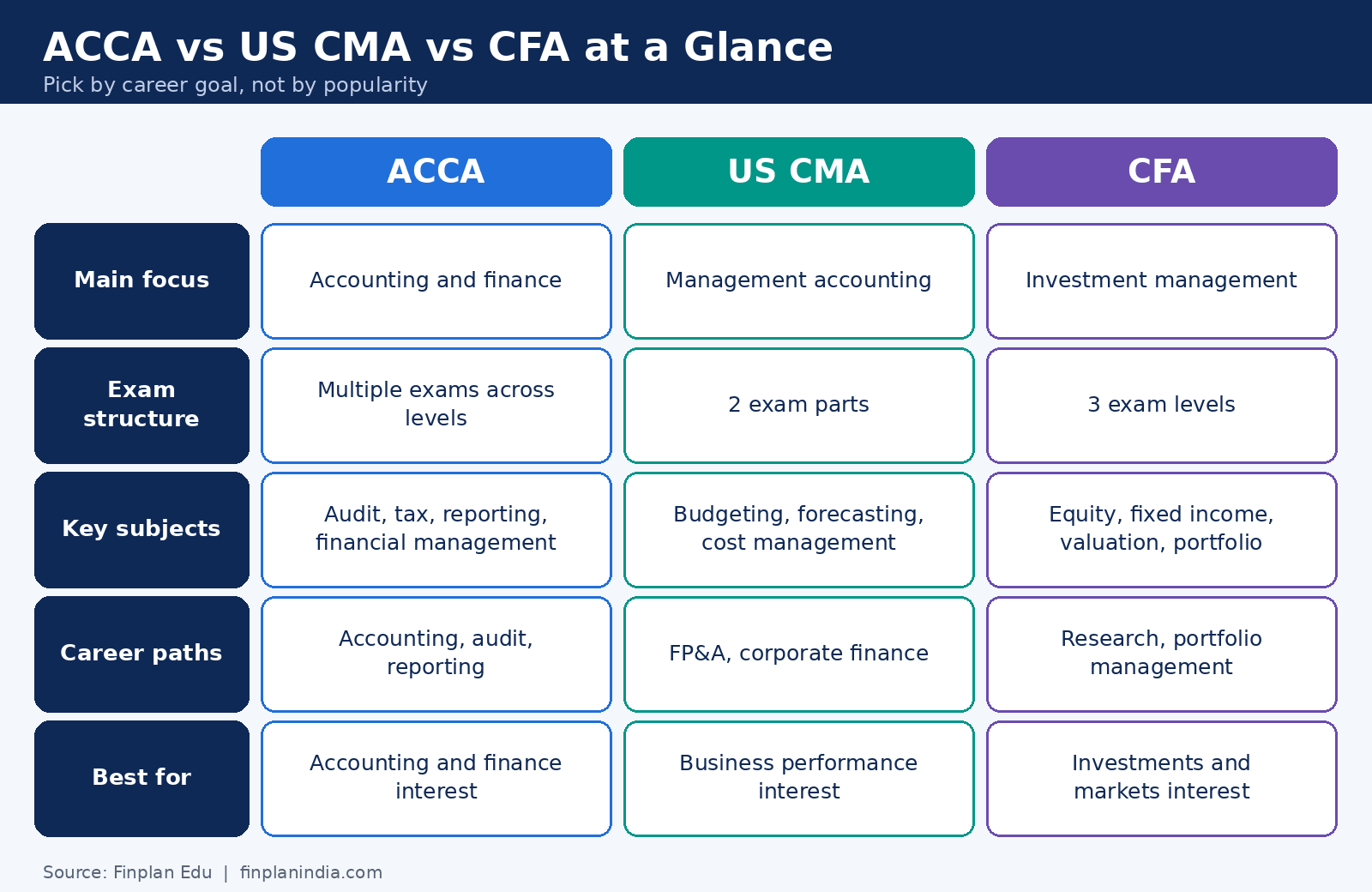
ACCA vs CMA vs CFA - Which Certification Should You Choose

Comparison

ACCA

US CMA

CFA

Main focus

Accounting and finance

Management accounting

Investment management

Exam structure

Multiple exams across levels

2 exam parts

3 exam levels

Key subjects

Audit, taxation, reporting, financial management

Budgeting, forecasting, cost management, analytics

Equity, fixed income, valuation, portfolio management

Suitable career paths

Accounting, audit, reporting

FP&A, management accounting, corporate finance

Investment research, portfolio management

Best suited for

Students interested in accounting and finance

Students interested in business performance

Students interested in investments and markets


So remember that these qualifications have different eligibility, experience and examination requirements.

How To Decide Which Certification Is Right For You:

●    Identify your career interest - Decide whether you prefer accounting, management accounting, investment research or corporate finance.
●    Review job descriptions - Look at the qualifications and technical skills employers mention for entry level positions.
●    Check your existing knowledge - If your MBA already covered certain subjects in depth consider a programme that develops new skills instead of repeating what you know.
●    Compare the commitment - Look at examination requirements, preparation time, course fees and work experience requirements before enrolling.
●    Think about practical learning - Choose a programme that helps you apply financial concepts through assignments, case studies or real-world exercises.

Why Should You Consider Certifications After MBA Finance

How To Plan Your Upskilling After MBA Finance

First start by identifying the areas where you need improvement. You should also consider whether you want to work in India or look for some international career opportunities. 
A good learning plan should give you enough time to study and practise. Trying to manage multiple certifications together can become difficult especially when you are also preparing for job interviews.

Here is a simple approach you can follow.

1.    Choose a career direction - Select a field like accounting, investment management, corporate finance or wealth management.
2.    Research relevant qualifications - Compare ACCA, US CMA, CFA and specialised short courses based on your chosen field.
3.    Check eligibility and exemptions - Review the official requirements before paying registration or course fees.
4.    Build practical skills - Practise Excel, financial analysis, communication and other technical skills relevant to your target role.
5.    Prepare for job applications - Work on your resume, complete relevant projects and apply for suitable internships or entry level positions.

Finplan Edu offers professional finance qualifications and learning pathways for students looking to develop specialised finance knowledge. Its programmes include ACCA, US CMA, ICWIM, CFMA + iBCom Pathway and a PG Certificate in Investment Banking and Wealth Management.
Classes are available online and offline in Mumbai and Thane, with online options in several other Indian cities. The best programme depends on your current qualification and your career goals.
Remember your MBA is not the end of your education. The next step should be based on the skills you want to develop and the opportunities you want to explore.

FAQs

1. Which certification is best after MBA Finance?

There is nothing like a single best certification for everyone. ACCA is suitable for accounting and financial reporting and US CMA focuses on management accounting and CFA is relevant to investment management. Your career goals should help you while deciding.

2. Is ACCA after MBA Finance worth it?

Of course, yes! ACCA can be useful if you want to specialise in accounting, audit, financial reporting or financial management. It adds professional accounting knowledge to the broader business understanding gained through an MBA.

3. Can I pursue CMA after MBA?

Yes, MBA graduates can pursue US CMA if they meet the eligibility requirements. The qualification covers budgeting, forecasting, performance management and strategic financial management.

4. Is CFA after MBA a good choice?

CFA can be a good pick if you are interested in investment analysis, equity research, portfolio management or financial markets. It requires preparation for three examination levels and relevant professional experience to earn the charter.

5. What are the best short courses for MBA Finance graduates?

Financial modelling, investment banking, financial statement analysis, wealth management and advanced Excel are useful options. Pick a course based on the technical skills required for your target job.

6. Does an MBA Finance guarantee a job in the finance industry? 

To be very honest, an MBA in Finance does not guarantee a job, but it provides a strong foundation in finance and business. Employers also value practical knowledge, communication skills, internships and relevant work experience.
Adding a professional qualification like ACCA, US CMA or CFA can further strengthen your profile and prepare you for specialized finance roles. 

7. Is ACCA and MBA a good combination for working abroad?

It can be a useful combination very particularly for careers in accounting, financial reporting and finance management. Anyhow job opportunities depend on the country, employer requirements, relevant experience and any local professional regulations.


 

MBA Finance Grads…. Here Comes Finplan Edu Courses For You…

Finplan Edu gives globally recognised finance qualifications, expert led classes and flexible learning options for students and graduates. You can find the available programmes and find a learning path that matches your career goals.
Take a look at Finance Courses at Finplan Edu and make your next move towards building your finance career.

Explore Finance Courses at Finplan Edu:

Email: enquiries@finplanindia.com
Call: 9029007248
Visit us: Finplan Edu on Google Maps

Have questions? Contact us