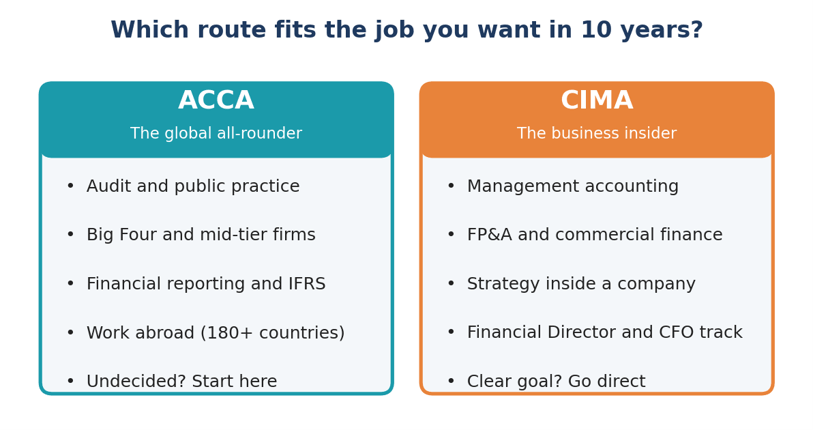

Your Global Finance Career is Loading…

CIMA vs ACCA 2026: Which Qualification Is Better for Your CFO Career?

CIMA or ACCA? If you are a B.Com graduate or finance executive in India, this question is probably on your mind. This Finplan Edu guide compares CIMA vs ACCA 2026 on structure, difficulty, salary and global reach, with salaries in rupees.
Quick Snippets

CIMA vs ACCA information by Finplan Edu

CIMA or ACCA: Which One Should You Choose?

I get asked this constantly: CIMA or ACCA, which one should I do? It is one of the biggest career decisions an accounting professional makes. Get it right and it speeds everything up. Get it wrong and you spend years in roles that do not fit. My answer is always the same: it depends on what you want to do and where you want your career to go. Do not pick the one that sounds more impressive or the one your friend is doing. Finplan Edu has spent over 15 years in professional finance education and has helped more than 15,000 learners build careers through globally recognised qualifications. Here we compare CIMA and ACCA on structure, difficulty, salary and career options.

What Is CIMA and Who Is It For?

CIMA stands for the Chartered Institute of Management Accountants, which is the CIMA full form most people search for. The word management is the key. Unlike audit paths that look back at historical records, CIMA focuses on forward-looking commercial finance and strategy. The CIMA professional qualification has four levels, and you can skip the Certificate level with a relevant degree. Its case studies, OCS, MCS and SCS, test whether you can think like a senior decision maker. It suits people who want to work inside a company on planning and business decisions.

Where CIMA Gives You the Biggest Edge
CIMA is strong in UK corporate finance and FP&A, which means financial planning and analysis. It is respected across Commonwealth countries. It is also growing in the US through a partnership with the AICPA, explained on the AICPA and CIMA UK page. Planning cycles and commercial decisions in large companies reward exactly this thinking.

CIMA works best for these roles:

•    Financial Director or CFO: it gives the most direct route into senior in-house finance leadership.

•    FP&A manager: you learn to build forecasts and explain why the numbers moved.

•    Commercial finance partner: you advise sales teams on pricing, margins and investment decisions.

•    Corporate finance professional: UK and Commonwealth employers value it.

•    Strategy-focused leader: case studies train you to decide with incomplete information.

What Is ACCA and Who Is It For?

ACCA stands for the Association of Chartered Certified Accountants, a global professional body. It suits audit, public practice, financial reporting and technical accounting. The qualification has 13 exams across three stages, plus an ethics module and practical experience. ACCA has over 252,000 members and is recognised in 180 countries, about four times the market size of CIMA. That scale comes from versatility across audit, tax, reporting, industry and the public sector. If you do not yet know your exact path, that breadth opens more doors early.

ACCA Online Courses for Working Learners

Many Indian learners choose ACCA online courses so they can study around a job. Online learning for ACCA works from Pune, Hyderabad, Bangalore, Chennai, Delhi, Kolkata, Ahmedabad, Kerala and Surat. Finplan Edu offers ACCA, US CMA and CISI, plus integrated programs like B.Com International with ACCA. See the Finplan Edu ACCA course page for details.


CIMA vs ACCA Exams and Difficulty

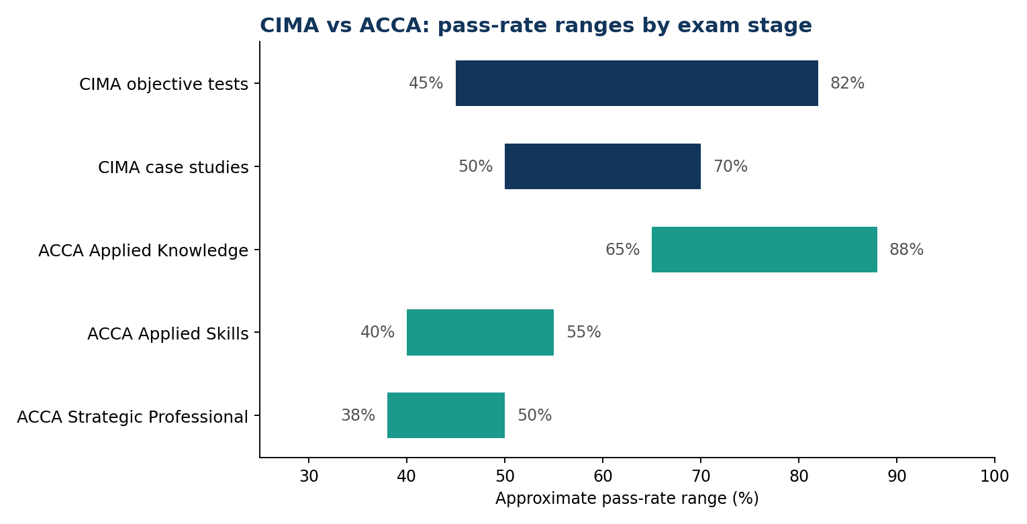
Both routes are demanding, so it helps to see where the climb gets steep. ACCA is a marathon of 13 exams, and the early Applied Knowledge papers are fairly generous. Things get real at Applied Skills, where pass rates drop to around 40% to 55%. Strategic Professional is tighter still. CIMA mixes flexible objective tests with four case study windows a year. Plan your study calendar early, because ACCA's higher levels have fixed dates.

Feature

CIMA

ACCA

Structure

4 levels: Certificate, Operational, Management, Strategic

13 exams: 3 Applied Knowledge, 6 Applied Skills, 4 Strategic Professional

Exam format

Objective tests plus OCS, MCS and SCS case studies

On-demand computer-based exams early, fixed sessions later

Pass rates

Objective tests mid-40s to low 80s, case studies 50% to 70%

Knowledge mid-60s to high-80s, Skills 40% to 55%, Strategic 38% to 50%

Exam timing

Tests on demand, case studies four times a year

March, June, September and December at higher levels


CIMA vs ACCA Exams and Difficulty

Pass-rate ranges climb steeper at higher levels.

These habits help with the difficulty:

•    Map the year early: fixed ACCA sessions need a calendar before you start.
•    Build momentum early: early papers are more forgiving.
•    Give Applied Skills extra time: pass rates drop to around 40% to 55% here.
•    Practise CIMA case studies under time pressure: write full answers, not just read solutions.
•    Check exemptions first: with a B.Com, an ACCA exemption calculator shows which papers you may skip.


CIMA vs ACCA Salary in India

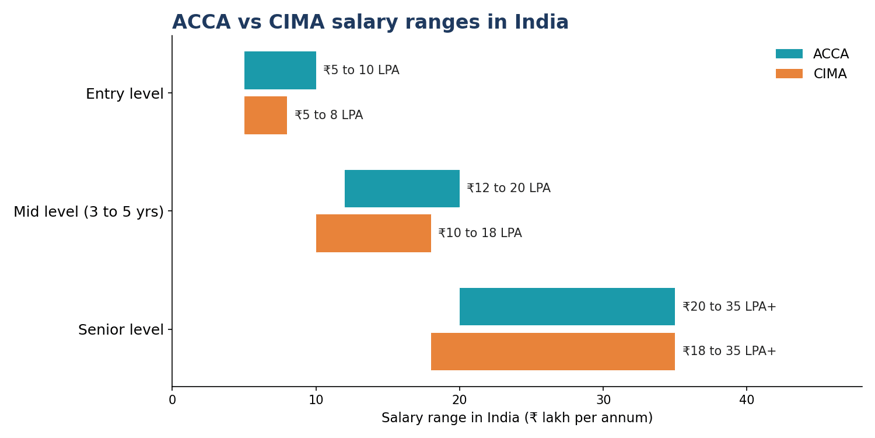
Salary is the question most students ask first. ACCA and CIMA professionals in India earn comparable entry-level salaries (₹5 to ₹8 LPA). ACCA generally offers broader job opportunities and slightly higher mid-level potential, thanks to high demand in Big 4 accounting firms and Global Capability Centers (GCCs). CIMA converges strongly at senior leadership and on the CFO and FP&A tracks. At senior level, pay depends more on job title and sector than on the letters after your name. The table below shows ranges by experience.

Experience level

ACCA salary (India)

CIMA (CGMA) salary (India)

Entry level (fresher or affiliate)

₹5 to ₹10 LPA

₹5 to ₹8 LPA

Mid level (3 to 5 years)

₹12 to ₹20 LPA

₹10 to ₹18 LPA

Senior level (finance manager, controller, CFO)

₹20 to ₹35 LPA+, up to ₹50 to ₹80 LPA in top MNCs and GCCs

₹18 to ₹35 LPA+, up to ₹50 LPA+ at executive levels


CIMA vs ACCA Salary in India

Core differences that affect pay

•    ACCA focus: financial accounting, global auditing, taxation and IFRS. Common roles are audit associate, financial reporting manager and internal auditor.

•    ACCA hirers: KPMG, Deloitte, EY and PwC are the top recruiters in India.

•    CIMA focus: management accounting, commercial finance, business strategy and FP&A. It awards the CGMA designation. Common roles are management consultant, finance controller and FP&A lead.

•    CIMA hirers: multinational corporations, ITES firms and shared service centres such as Accenture and American Express.

•    ACCA demand: much wider recognition and roughly 5x to 8x more openings than CIMA, which means faster placement and slightly more liquidity in mid-tier pay packets.

•    CIMA demand: more niche in India, but strong value if you target the internal corporate ladder, commercial finance or the CFO track inside multinationals.

Career Paths and Global Opportunities

ACCA dominates the Big Four and mid-tier audit firms, as well as core financial reporting roles. Those employers build their teams around ACCA-qualified people. Its biggest strength is portability, with demand in the Middle East, Asia and Africa where most employers know it instantly. If CIMA is the business-world insider, ACCA is the global all-rounder. CIMA, meanwhile, is a powerhouse in corporate finance and FP&A. The table below matches common goals to the better fit.

Your goal

Better fit

Why

Audit or public practice

ACCA

Big Four and mid-tier firms are built around ACCA headcount.

Working abroad

ACCA

Recognised in over 180 countries, with strong Middle East, Asia and Africa demand.

FP&A and corporate finance

CIMA

The syllabus and case studies focus on business decisions.

Financial Director or CFO

CIMA

It is the more direct route to leading finance inside a business.

Not sure yet

ACCA

Breadth gives you time to decide and specialise later.

ACCA is the safer choice when these points apply to you:

•    You want to work in audit or practice at a Big Four or mid-tier firm, where ACCA is the standard.
•    You plan to move abroad, especially to the Middle East, Asia or Africa.
•    You are unsure of your direction and want options across audit, tax, reporting, industry and the public sector.
•    You are a B.Com graduate who wants more doors open early in your career.
•    You may specialise later, since going from broad to focused is easier than the reverse.

Which Should You Pick? Our Recommendation

If you want to work inside a business, head up finance and become a CFO, CIMA is the more direct route. If you want audit, practice, reporting or a job abroad, ACCA is the safer choice. If you are still asking should I study CIMA or ACCA, start with ACCA. Its breadth gives you more time to decide, and you can specialise later. Going the other way is harder. Base your choice on the job you want in ten years, not on which sounds more impressive.

•    Choose CIMA if you want to become Financial Director or CFO and enjoy planning and strategy.
•    Choose CIMA if you want UK corporate finance or FP&A work and like case-study exams.
•    Choose ACCA if you want audit or public practice at a Big Four or mid-tier firm.
•    Choose ACCA if you may work in the Middle East, Asia or Africa.
•    Start with ACCA if you are undecided, because you can specialise later.

Advice for B.Com Graduates and Finance Executives

B.Com graduates can save time by checking exemptions before they enrol. An integrated route such as B.Com International with ACCA lets you study the degree and qualification together. Finance executives should look at their current team first. If it is planning-heavy, CIMA may fit, and if it is audit or reporting-heavy, ACCA usually fits better.

Pick based on the job you want in 10 years


Frequently Asked Questions

1. Is CIMA better than ACCA for becoming a CFO?

CIMA is the more direct route for rising inside a business to Financial Director or CFO. ACCA can get you there too, but CIMA is built around that path.

2. Is ACCA better than CIMA for audit?

Yes. Big Four and mid-tier firms are built around ACCA-qualified staff, so it is the clear choice for audit and practice.

3. Which is more internationally recognised?

ACCA, which is recognised in over 180 countries. CIMA is respected across Commonwealth countries and growing in the US.

4. Which qualification has more exams?

ACCA has 13 exams across three stages. CIMA has four levels, and Certificate can be skipped with a relevant degree.

5. What salary can a CIMA professional earn in India?

Entry level is around ₹5 to ₹8 LPA. With 3 to 5 years of experience, expect roughly ₹10 to ₹18 LPA.

6. What salary can an ACCA professional earn in India?

Entry level is around ₹5 to ₹10 LPA, rising to roughly ₹12 to ₹20 LPA at mid level.

7. Should an undecided student choose ACCA or CIMA?

Start with ACCA. Its breadth gives you time to work out your direction, and you can specialise later.

8. Can CIMA lead to a CFO career?

Yes. Senior CIMA salaries in India start around ₹18 LPA and reach ₹50 LPA+ at executive levels.

9. Is ACCA good for working abroad?

Yes. It works like a global career passport, with strong demand in the Middle East, Asia and Africa.

10. Which is better for corporate finance?

CIMA is a powerhouse in corporate finance and FP&A, though ACCA has more openings in India.


Ready to Choose Your Path?

Both CIMA and ACCA can genuinely change your career trajectory, but only if the day to day work fits what you enjoy.
If you are still weighing eligibility, cost or syllabus details, take a closer look at Finplan's complete ACCA course guide before deciding. CIMA or ACCA, which is actually calling you? If you are still confused, Finplan can help you choose the path that best fits your career goals.

Contact our specialised ACCA experts at Finplan Edu for help with ACCA books or syllabus. Finplan Edu is one of the proud ACCA Platinum Approved Learning Partners in India, serving students everywhere. Contact us today at +91 9029007248 or enquiries@finplanindia.com, or book a free consultation for personalized guidance on which books and study path suit you best.

Have questions? Contact us