
Your Global Finance Career is Loading…

How to Balance ACCA With Full-Time College or a Job: A Practical Study Guide

Pursuing ACCA while attending college or working full-time can be challenging. Between lectures, assignments, office deadlines and personal commitments, finding enough time for examination preparation often becomes difficult. However, managing both responsibilities is possible with a realistic study plan and consistent preparation habits. You do not necessarily need to spend several hours studying every evening. Understanding your priorities, choosing suitable examination papers and using your available time effectively can make preparation more manageable. Whether you are a college student in India or a working professional looking to advance your finance career, this guide explains practical ways to balance ACCA with your everyday responsibilities.
Quick Snippets

Balance ACCA with college or a job

Audit Your Daily Routine Before Creating an ACCA Study Plan

The first step towards managing ACCA alongside college or employment is understanding how you currently spend your time. Creating a study timetable without reviewing your existing commitments can lead to unrealistic expectations.
Start by tracking your daily activities for a few days. Record the time spent attending lectures, working, commuting, completing assignments, using social media and resting.
This exercise can help you identify periods that could be used more productively without compromising essential responsibilities.

Here are five practical ways to conduct a daily time audit:

●    Track your daily activities: Record how much time you spend on different tasks to understand which commitments occupy most of your day.
●    Identify unnecessary distractions: Review the time spent scrolling through social media or watching entertainment and consider whether some of it could be redirected towards studying.
●    Recognise your productive hours: Identify when you can concentrate most effectively, whether that is early in the morning, during the afternoon or after work.
●    Separate essential and flexible commitments: Distinguish responsibilities such as college attendance, employment and sleep from activities that can be rescheduled.
●    Set realistic study expectations: Determine how much time you can consistently dedicate to ACCA preparation before setting daily and weekly targets.

For example, reducing unnecessary screen time by 30 minutes in the morning and evening could create an additional hour of study time.
The objective is not to eliminate leisure activities. It is to develop a routine that accommodates your academic, professional and personal needs.

Use Time Blocking to Create an Effective ACCA Study Timetable

Time blocking involves assigning specific periods of your day to planned activities. Instead of waiting until you have free time, you decide when you will study and what you intend to accomplish.
This approach can be particularly useful for students and professionals whose schedules are already occupied by other responsibilities.
Short, focused study sessions may be easier to maintain than several uninterrupted hours of preparation.
For example, working professionals could dedicate their morning sessions to understanding concepts and their evening sessions to examination questions.

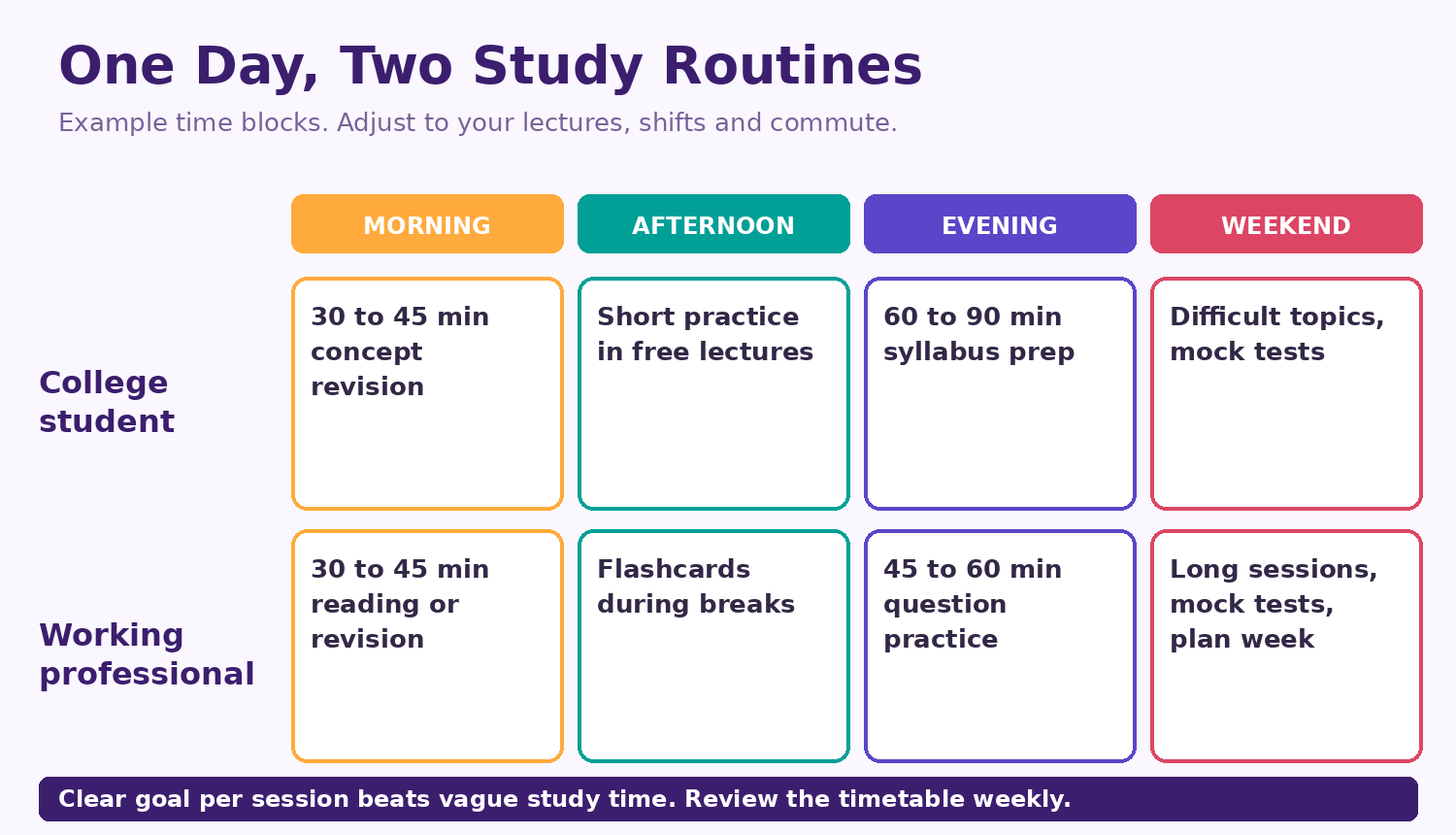
The following timetable illustrates how ACCA preparation can fit into different daily routines:

Study Period

College Students

Working Professionals

Morning

30 to 45 minutes of concept revision

30 to 45 minutes of reading or revision

Afternoon

Short practice during free lectures

Flashcards during available breaks

Evening

60 to 90 minutes of syllabus preparation

45 to 60 minutes of question practice

Saturday

Difficult topics and detailed practice

Longer study sessions

Sunday

Mock tests and weekly revision

Mock tests and upcoming week planning


This timetable is an example rather than a compulsory schedule.
Students should adjust their study blocks according to college timings, working hours, examination dates and personal commitments.
Giving each study session a clear objective can also improve concentration. Instead of planning to study accounting for an hour, decide which concept or question set you intend to complete.
Regularly reviewing your timetable can help you identify whether your study routine remains practical.

The following timetable illustrates how ACCA preparation

Choose ACCA Papers That Complement Your College Subjects

Students pursuing ACCA alongside a commerce, accounting or finance degree may find similarities between their university subjects and ACCA examinations.
For example, a student studying Financial Accounting in college may already understand several concepts relevant to the ACCA Financial Accounting paper.
Recognising these similarities can help students organise their preparation more efficiently.
However, university examinations and ACCA examinations may have different learning outcomes, question formats and assessment requirements.

Consider the following steps before selecting your ACCA papers:

●    Compare academic syllabuses: Identify topics covered in both your college curriculum and the relevant ACCA examination to understand where your existing knowledge may be useful.
●    Prioritise familiar subjects where appropriate: Consider preparing for papers containing concepts you have recently studied, provided your examination eligibility and progression requirements allow it.
●    Check exemption eligibility: Review whether your academic qualification or institution makes you eligible for exemptions before registering for examinations.
●    Identify differences in examination requirements: Understand how ACCA assesses familiar concepts, particularly where application-based questions differ from university assessments.
●    Practise ACCA-specific questions: Use relevant examination resources to strengthen your understanding and become familiar with the required answer formats.

For example, knowledge of management accounting from college may help you understand budgeting and costing concepts more quickly.
Nevertheless, you should still practise questions based on the ACCA syllabus and examination pattern.
Selecting papers thoughtfully can reduce unnecessary repetition while allowing you to concentrate on developing the knowledge required for your remaining examinations.

Set Weekly Study Goals and Make the Most of Your Weekends

When balancing ACCA with college or work, completing the entire syllabus can initially feel overwhelming.
Breaking your preparation into weekly objectives makes it easier to monitor progress and identify areas requiring additional attention.
Rather than setting a broad target such as completing Management Accounting, divide the subject into smaller topics and measurable learning activities.
Your weekly goals could include understanding a particular chapter, completing a practice assessment and reviewing incorrect answers.

The following example demonstrates how students can organise their weekly preparation:

Day

Suggested Study Focus

Monday

Learn a new syllabus topic

Tuesday

Revise concepts and technical terminology

Wednesday

Complete topic-wise practice questions

Thursday

Practise more challenging questions

Friday

Review mistakes and learning gaps

Saturday

Complete detailed revision or difficult topics

Sunday

Attempt a timed assessment and plan the next week


Weekends are particularly useful for activities requiring longer periods of concentration.
Working professionals can reserve weekend study blocks for complex chapters, mock examinations and detailed question practice.
College students can use weekends to revise topics covered throughout the week and prepare for upcoming assessments.
If you have university examinations or important workplace deadlines, adjust your weekly targets accordingly.
Maintaining a flexible routine is often more practical than following a timetable that leaves no room for unexpected responsibilities.

Use Digital Learning Resources to Support ACCA Preparation

Digital learning tools can make ACCA preparation more accessible for students who cannot attend traditional classroom sessions every day.
Online learning resources allow students to revise concepts, practise questions and organise their preparation during available study periods.
For working professionals, this flexibility can be particularly useful when office schedules or commuting requirements limit dedicated study time.
Students should prioritise reliable resources that align with their selected examination syllabus.

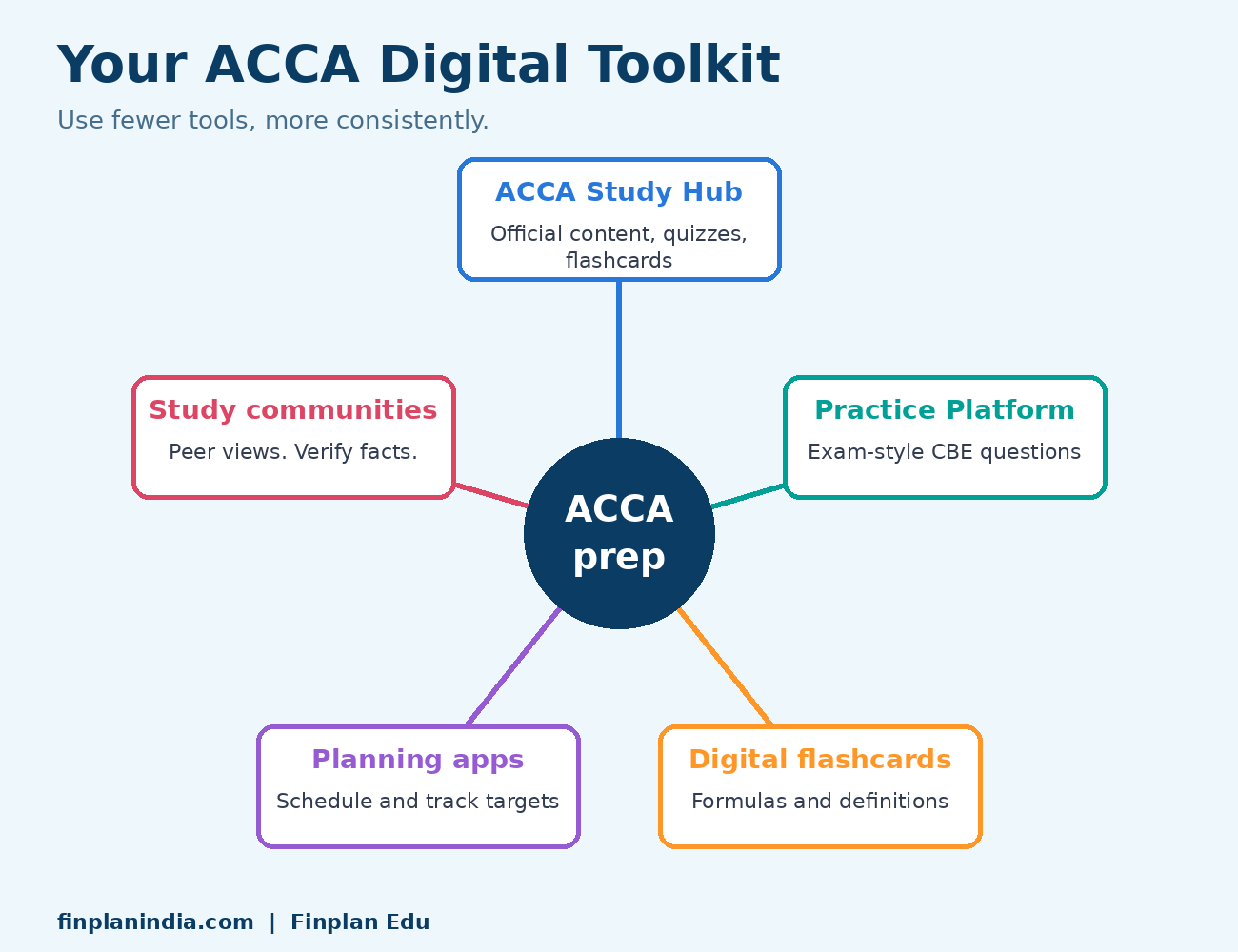
The following digital tools can support different aspects of ACCA preparation:

●    ACCA Study Hub: Eligible registered students can access official study content, quizzes, revision questions and flashcards to develop their understanding of examination topics.
●    ACCA Practice Platform: Students can practise examination-style questions and become familiar with the computer-based assessment environment.
●    Digital flashcards: Revision applications can help students revisit formulas, definitions and important concepts during shorter study sessions.
●    Study planning applications: Calendar and task management tools can help students schedule preparation activities, track weekly targets and monitor examination deadlines.
●    Online study communities: Discussions with other ACCA students can provide different perspectives on challenging topics, although technical information should always be verified against reliable resources.

Students can also explore online classes and digital learning materials offered by Finplan Edu.
When choosing a learning resource, consider whether it supports your examination requirements rather than simply providing additional information.
The official ACCA Study Hub is a useful starting point for exploring study content and examination preparation resources.
Using a smaller number of relevant resources consistently may be more effective than switching between multiple platforms without a clear purpose.

Use Digital Learning Resources to Support ACCA Preparation

Manage Stress, Avoid Burnout and Maintain Consistency

Preparing for ACCA while studying or working full-time requires managing both your time and energy.
An overly demanding timetable may initially appear productive, but maintaining it over several months can become difficult.
Students should avoid sacrificing adequate sleep, regular meals and essential personal commitments simply to increase their daily study hours.
The video recommends studying for approximately one to two hours daily as a practical starting point. However, the appropriate preparation time depends on the selected examination, existing knowledge and available study period.
Taking short breaks between study sessions can help students maintain concentration. Regular exercise, meditation or other relaxing activities may also support a more balanced routine.
If you find yourself struggling to meet your study targets, review whether your timetable is realistic rather than immediately increasing your workload.
Consistency is particularly important because ACCA examinations cover a broad range of financial, accounting and business concepts.
Regularly revisiting topics can help reinforce understanding and identify difficulties before the examination approaches.
For example, completing a manageable set of questions each evening may be more sustainable than attempting several chapters during a single exhausting weekend.
Focus on the quality of your preparation rather than comparing your study hours with those of other students.

How Finplan Edu Helps Students Balance ACCA With College or Work

Preparing for a professional qualification independently can sometimes become difficult, especially when students are unsure how to organise their learning or assess their examination readiness.
Structured academic guidance can help students identify priorities and develop a preparation approach that accommodates their existing responsibilities.
At Finplan Edu, students can explore structured study plans, learning materials, examination tips and career planning guidance.
Students pursuing professional courses alongside college can seek guidance on selecting suitable papers and understanding relevant examination requirements.
Working professionals can enquire about available learning options, including online classes, to determine whether the teaching schedule suits their commitments.
Before enrolling, students should understand the course fees, examination pattern, qualification requirements and available academic support.
Whether you are based in Thane, Mumbai or elsewhere in India, choosing a suitable learning arrangement can help you maintain a more organised preparation routine.
The objective is to combine academic guidance with independent practice and consistent revision.
Building a sustainable study routine can help you approach ACCA examinations with greater clarity while continuing to fulfil your academic or professional responsibilities.

Frequently Asked Questions (FAQs)

1. Can I pursue ACCA alongside full-time college?

Yes. Students can prepare for ACCA alongside college by creating realistic study schedules, identifying overlapping academic subjects and selecting manageable examination targets.

2. Is it possible to study ACCA while working full-time?

Yes. Working professionals can divide their preparation into shorter weekday sessions and longer weekend study blocks. Flexible learning arrangements may also help accommodate work commitments.

3. How many hours should I study for ACCA every day?

One to two hours of focused daily preparation can be a starting point. However, required study hours depend on the examination, preparation period and your understanding of the subject.

4. Which ACCA papers should college students attempt first?

Students may consider papers that complement their academic subjects, such as Financial Accounting or Management Accounting, subject to applicable exemption eligibility and examination progression requirements.

5. Can online classes help working professionals prepare for ACCA?

Online classes can provide greater flexibility when managing work commitments. Students should compare teaching schedules, learning resources and academic support before choosing a course.

6. How can I avoid burnout while preparing for ACCA?

Create achievable study targets, take regular breaks and maintain sufficient sleep. Adjust your timetable during demanding academic or professional periods instead of overloading yourself.

7. Can I complete the ACCA certification while pursuing a degree?

You can work towards completing ACCA examinations alongside a degree. The full membership journey also includes applicable ethics and practical experience requirements, so completion timelines vary.


Build an ACCA Study Routine That Works for You

Want to discover practical ways to manage ACCA preparation alongside full-time college or employment?
Watch the full video for a walkthrough.
If you are searching for ACCA classes near me or need guidance on creating a preparation schedule that suits your commitments, connect with Finplan Edu to explore your learning options.
Visit us: Google Maps
Email: enquiries@finplanindia.com
Call: 9029007248

Have questions? Contact us