
Your Global Finance Career is Loading…

ACCA Study Plan for Working Professionals: A Weekday and Weekend Strategy

Studying for ACCA after a full day at work is hard. You get home tired, weekends fill up with family and errands, and free time disappears. The good news is that an ACCA study plan for working professionals does not need endless hours. It needs a steady routine that fits your life. This guide covers ACCA preparation while working full time, paper by paper, as a complete ACCA exam preparation strategy.

Quick Snippets

ACCA Study Plan for Working Professionals

Why Consistency Beats Cramming When You Work Full Time

Most people with a full-time job cannot study six hours a day, and they do not need to. Learning how to prepare for ACCA while working is about rhythm, not marathon sessions. Short, regular sessions help you remember far more than one late-night push before a mock. Think of your week in two halves: study smart on weekdays and apply it on the weekend. This ACCA exam study strategy lets your job, your family and your exams all move forward together. ACCA also shares its own advice on managing work and study. These ideas make the rhythm work, and they are the core of how to balance ACCA and work:

•    Aim for one to two focused hours on weekdays, because a small daily habit adds up faster than an occasional long session.

•    Study when your mind is clear, usually early morning or late evening, so the same hour gives better results.

•    Pick one topic per session and go deep, since spreading yourself across five topics leaves you remembering none of them.

•    Keep weekends for practice and revision, which is where weekday learning turns into real exam skill.

•    Check your progress every week and adjust, so one missed day becomes a small correction instead of a reason to quit.
ACCA Study Hours and Your Weekly Timetable

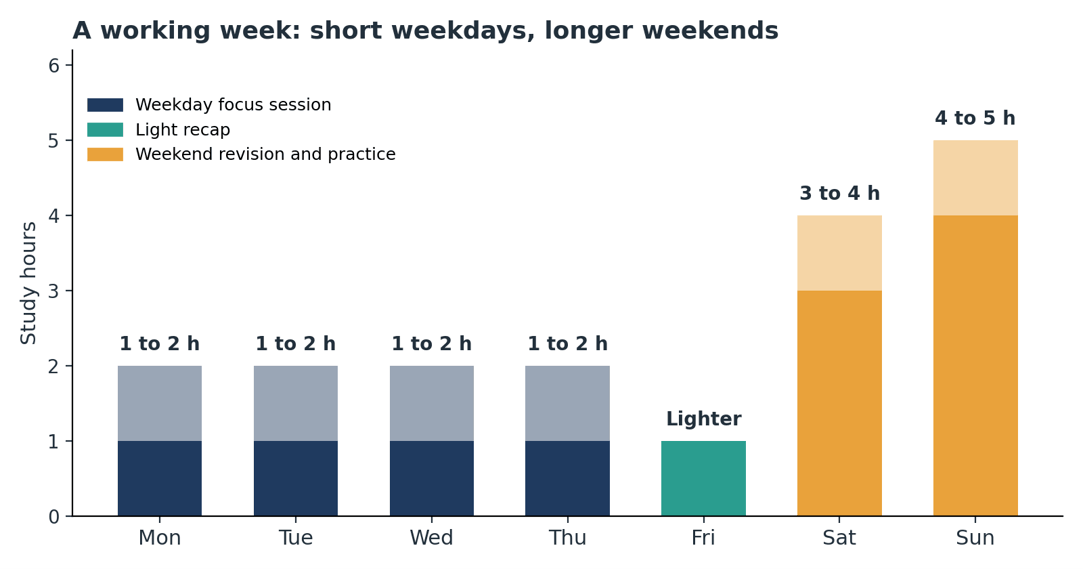
A realistic ACCA study timetable for working professionals starts with honest numbers about your week. Your ACCA weekday study schedule should be one to two focused hours, which is enough if you protect that time. Your ACCA weekend study plan is simple: Saturday is for revision and Sunday is for full exam-style practice. ACCA offers a free tool, the ACCA Compass Planner, where you block out days you cannot study and review your plan every week. It helps with ACCA time management for working professionals. The table and diagram below show how the hours are split.


Day

Study time

What to do

Monday to Thursday

1 to 2 hours

Study one topic in depth, then solve 2 or 3 short practice questions

Friday

Lighter session

Watch a short revision video or take a quick recap quiz

Saturday

3 to 4 hours

Revise the week, update formula sheets, take short mock tests, mark weak areas

Sunday

4 to 5 hours

Do full exam-style practice, then review every mistake straight away


ACCA Study Hours and Your Weekly Timetable

Figure 1: Suggested study hours across a working week

Planning the Foundation Papers: BT, FA and MA

Many BBA and BCom graduates can claim exemptions from the knowledge-level papers, depending on their university's ACCA accreditation. If that applies to you, skip what you already know and spend your time on ACCA-specific concepts and exam-style practice. The three foundation papers are Business and Technology, Financial Accounting and Management Accounting. Each needs a slightly different weekday approach, but all three reward practice over theory recap. Good ACCA paper planning starts here, and the ACCA study guide for Management Accounting lists exactly what the exam covers.
Here is how to handle each paper:


•    Business and Technology: focus on governance, ethics, information systems and business structures, and keep notes to one page per topic.

•    Business and Technology: read those notes for 10 minutes before sleep, and end each session by writing one question you missed, then solve it first next time.

•    Financial Accounting: solve two or three short questions daily on double entry, trial balances and financial statements to build speed and accuracy.

•    Financial Accounting: by the end of the week, you should be able to prepare a full set of financial statements from raw figures.

•    Management Accounting: study one concept a day, such as marginal costing, absorption costing or flexible budgeting, and reinforce it with quick drills.

•    All three papers: use your commute for short revision audios or business podcasts, so idle minutes count towards your ACCA revision strategy.

Pairing Theory and Technical Papers as You Move Up

Once the foundation papers are behind you, start combining theory-based and technical papers. A simple pairing is Corporate and Business Law with either Performance Management or Taxation. Study law on alternate weekdays and focus on principles instead of memorising every rule. On the other weekdays, work through three or four numerical questions for the technical paper. Then comes the technical trio of Financial Reporting, Financial Management and Audit and Assurance. ACCA technical papers preparation here is about depth and repetition, so keep each session to about 90 minutes and finish with two or three short questions.


Stage

Papers

Weekday approach

Weekend approach

Foundation

Business and Technology, Financial Accounting, Management Accounting

One concept a day, short drills

Revise, then full practice

Pairing

Corporate and Business Law with Performance Management or Taxation

Law on alternate days, numerical questions on the rest

Law review, then full numerical practice

Technical trio

Financial Reporting, Financial Management, Audit and Assurance

One concept per 90-minute session

Full sections under exam conditions

Strategic Professional

Strategic Business Leader, Strategic Business Reporting, advanced papers

Frameworks, governance, ethics

Timed mock simulations

Strategic Professional Level: From Knowledge to Judgment

At the strategic level, the goal shifts from knowing things to using professional judgment. Strategic Business Leader and Strategic Business Reporting are the two papers that build this skill. Weekday sessions should go on frameworks, governance, ethics and reporting standards. Weekends are for full mock simulations and timed practice, which build exam technique and stamina. Your ACCA strategic professional study plan also includes the option papers, such as Advanced Financial Management, Advanced Performance Management, Advanced Taxation and Advanced Audit and Assurance. For those, review core concepts on weekdays and solve comprehensive case-based mock papers on weekends.
ACCA mock exam preparation matters most at this stage, so keep these habits:

•    Use weekday sessions to understand why a framework exists, not just to memorise its parts.

•    Practise applying ethics and governance ideas to short business scenarios, because these papers reward judgment over recall.

•    Do full timed mock simulations on weekends to build the stamina that long, detailed scenarios demand.

•    Review core concepts for the advanced technical papers during the week, then test them on case-based mocks.

•    After every mock, write down where you lost marks and turn those points into the next week's weekday topics.

Study Techniques, the Ethics Module and Practical Experience

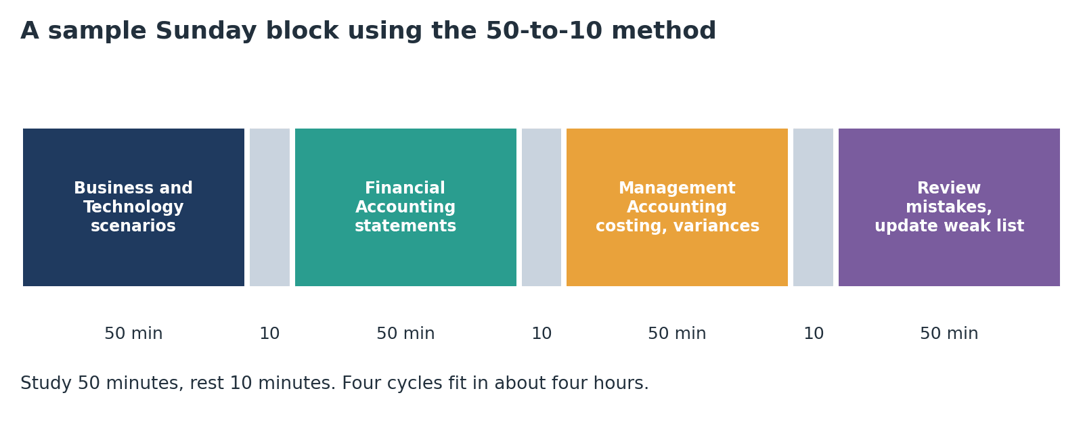
The 50-to-10 method is simple: study for 50 minutes, then take a 10-minute break. It keeps your focus sharp and helps you avoid burnout after a long workday. The diagram shows how a four-hour Sunday could look. Start the ACCA Ethics and Professional Skills Module early, ideally while you are still on the Applied Skills papers. It builds professional judgment, communication and analytical thinking, which help in exams and at work. At the same time, line up your job with the ACCA Practical Experience Requirement, so your studies and your work reinforce each other. The table lists techniques worth keeping.

50-to-10 method is simple ACCA Study

Figure 2: A sample Sunday block using the 50-to-10 method

Technique

How it works

Best used for

50-to-10 method

Study for 50 minutes, then rest for 10

Long weekday and weekend sessions

One-page notes

One page per topic, read for 10 minutes before sleep

Business and Technology

Weak-area list

Note what you missed, start the next session with it

Every paper

Commute audio

Short revision audios and podcasts

Idle time

ACCA Compass Planner

Block out busy days, set milestones, review weekly

Overall time management

Getting Support Without Giving Up Your Job or Weekends

You do not need to quit your job to earn ACCA. You need a plan that fits your lifestyle, and help when the syllabus gets heavy. Finplan Edu offers ACCA online and offline courses and supports students across Mumbai, Pune, Hyderabad, Thane, Bangalore, Chennai, Delhi, Kerala and Surat. Finplan Edu reports a 78% ACCA pass rate, which it says is 50% better than the industry average. Its ACCA programme, run within India, uses real-world scenarios in training.
Whichever route you choose, these steps keep your plan realistic:

•    Book each exam early, because ACCA says early booking costs less and leaves you enough study time.

•    Talk to a counsellor about your paper order, so exemptions, exam windows and your work calendar all line up.

•    Choose live or recorded online classes that match your shift pattern, so a late meeting never puts you behind.

•    Ask for feedback on every mock exam, because you only improve when you understand exactly why you lost marks.

•    Log your work tasks as you go, so your Practical Experience Requirement stays up to date while you study.

Frequently Asked Questions

How many hours should a working professional study for ACCA?

Aim for one to two focused hours on weekdays, three to four on Saturday and four to five on Sunday. Consistency matters more than a perfect number.

How should I divide ACCA study time between weekdays and weekends?

Use weekdays to learn one topic at a time and solve a few practice questions. Use Saturday for revision and short mock tests, and Sunday for full exam-style practice.

How do I prepare for ACCA while working full-time?

Build a routine of short weekday sessions, longer weekend practice and regular review of weak areas. Use commute time for revision audio.

What is the 50-to-10 study method for ACCA preparation?

You study with full focus for 50 minutes, then rest for 10 minutes, and repeat. The break helps you keep concentrating for longer and avoid burnout.

How should I plan ACCA papers while working?

Start with the foundation papers and skip what your exemptions cover. Then pair a theory paper with a technical one, and give the technical trio the depth it needs.

When should I start the Ethics and Professional Skills Module?

Start early, ideally while you study the Applied Skills papers. It builds professional judgment and communication skills, and it will not pile up near the end.


Ready to Build Your Own Plan?

Your ACCA journey can fit around your job, and you do not have to plan it alone. Talk to the counsellors at Finplan Edu and they will help you map your papers around your working hours. You can also call 9029007248, write to enquiries@finplanindia.com or find the Thane centre on Google Maps.

Have questions? Contact us