Your Global Finance Career is Loading…

How to Pass ACCA Management Accounting (MA): A Smart Study Strategy for 2026

Picture this: a factory manager must decide whether to ramp up production by 20% or scale it back before the quarter closes. The numbers look intimidating: material costs, labour shortages, thin margins. This isn't a textbook hypothetical. It's exactly what ACCA's Management Accounting (MA) paper is testing you on.And yet more than 70% of students fail this exam at least once, not because they can't do the math, but because they prepare for MA like a calculation test, when it's really a decision-making test wearing a numbers costume. Here's a study approach built around that one shift in mindset.

Quick Snippets

How to Pass ACCA Management Accounting (MA)

5 Mistakes That Quietly Sink ACCA MA Students

Before we get into what works, it helps to see where most students go wrong. These aren't obscure traps. They show up in examiner reports year after year.


•    Treating MA as a math paper, not a business paper. Students grind through calculations but freeze the moment a question asks them to explain a decision instead of just computing a number.

•    Skipping theory because "it never comes up." Definitions and assumptions get ignored in favour of practice sums, then show up on the paper in an unfamiliar way students can't handle.

•    Ignoring how examiners phrase questions. MA rarely just asks you to "calculate the variance"; it asks what that variance means for a real business decision.

•    Solving hundreds of practice questions instead of the right ones. Grinding through 500 generic questions builds speed, not judgement; reviewing fewer questions properly, with past papers and examiner reports, builds more.

•    Poor time and answer structure. MA gives roughly 1.5 minutes per mark, and students who never practise this under timed conditions run out of time on the questions worth the most.
The 3-Layer Study Framework That Actually Works

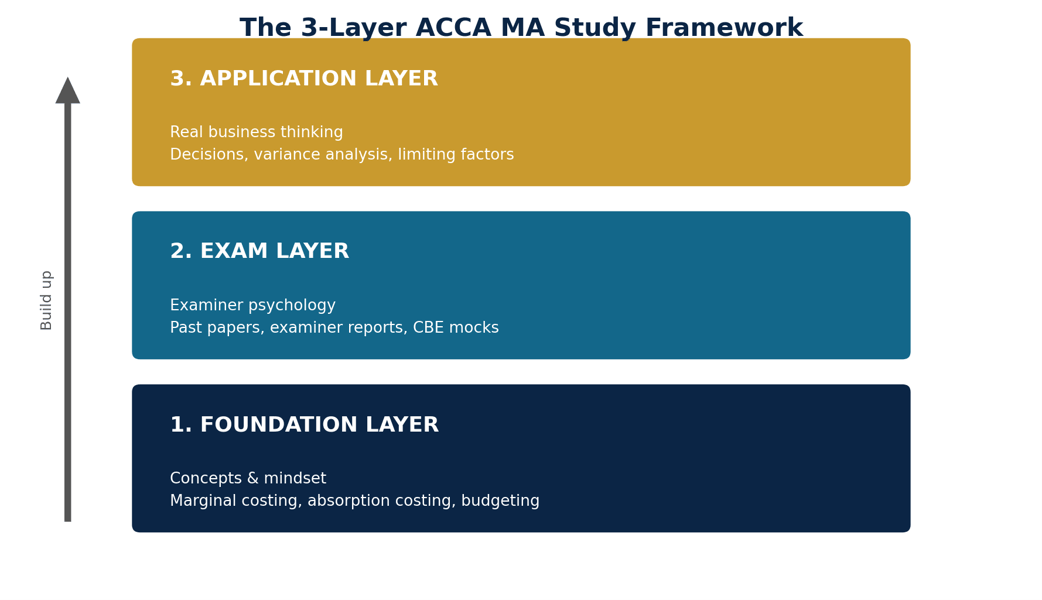
Instead of a generic week-by-week planner copied from a textbook publisher, build your MA preparation around three layers that stack on each other. Skipping one weakens everything built above it. You can't apply concepts you don't understand, and you can't walk in with strong application skills if you've never practised under real conditions.

The 3-Layer Study Framework That Actually Works

The three layers build on each other, from core concepts to real exam-style thinking.

Foundation Layer: Concepts and Mindset

The foundation layer is where you build genuine understanding of concepts like marginal costing, absorption costing, and budgeting. This isn't about memorising formulas in isolation. It's about understanding what each concept represents in a business context. Take marginal costing: once a streaming platform has produced a hit show, the cost of one more subscriber watching it is close to zero, which is exactly why these platforms can offer multiple profiles and still turn a healthy profit.

Exam Layer: Examiner Psychology

The exam layer is about understanding how ACCA tests what you know, which is different from simply knowing the material. Examiners are far more likely to ask what a favourable variance means for a company's pricing decision than to ask for the variance alone. Past papers, examiner reports, and computer-based mocks are your best tools here, because they show exactly how marks get allocated. Spend real time reading examiner reports; they tell you, in plain language, what past cohorts got wrong.

Application Layer: Real Business Thinking

The application layer is where the subject stops feeling like an exam and starts feeling like a business simulation. Every topic in MA shows up in real boardroom decisions every day: should a company open a new warehouse, why did sales miss forecast, how should a business split a scarce resource between product lines. When you train yourself to think through questions like these, exam scenarios stop feeling abstract. They start feeling familiar.

A quick snapshot of the exam itself, so you can plan your practice around the real format:

Exam Element

What to Expect

Format

Computer-based exam (CBE)

Duration

2 hours in total

Structure

Section A: objective test questions. Section B: scenario-based questions

Pass mark

50%

Best prep tools

Past papers, examiner reports, and CBE-style mock exams

Always confirm the exact structure and mark weighting on ACCA's official website, since formats are reviewed each syllabus cycle.

The Study Resources Actually Worth Your Time

Not all study material pulls its weight. If your prep time is limited, prioritise resources that build exam judgement, not just calculation speed.

•    Past exam papers from the last 3 to 4 sittings. They show the real range of question styles, not just the calculation-heavy ones, especially when done under timed conditions.

•    Examiner reports. Published after every sitting, they explain exactly where students lost marks and why, often more useful than another 50 practice questions.

•    Computer-based (CBE) mock exams. Practising on a similar interface removes the friction of learning new software on exam day and builds comfort with on-screen tools.

•    Spaced repetition for theory and definitions. Revisiting key definitions in short sessions spread across weeks moves information into long-term memory far better than cramming.

•    A structured answer template. For discussion questions, practise short answers with context, calculation, and a clear conclusion, since examiners mark against a scheme.

Real Students, Real Results

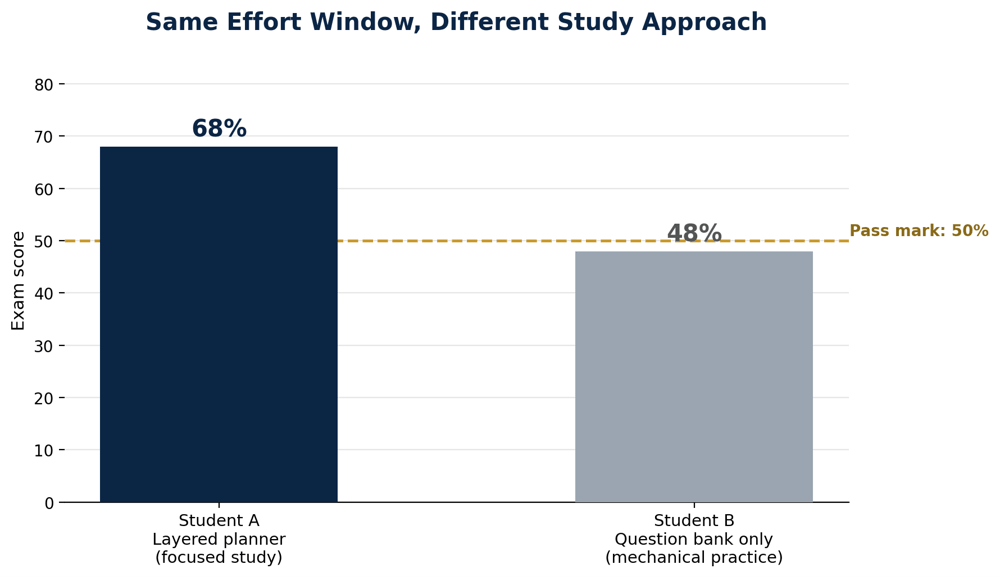
Two students preparing for the same sitting can end up with completely different outcomes based on how they studied, not how hard they studied. One spent six months on hundreds of numerical exercises, then froze on a question that asked him to explain, not calculate, a pricing decision. His preparation had trained his calculator, not his judgement, and he failed. Another covered less than half that question bank but focused on past papers, examiner reports, and a handful of realistic mocks. She passed on her first attempt with 72%. The pattern repeats across cohorts: a layered, examiner-aware approach consistently beats grinding through more questions.

Is ACCA MA harder than other Applied Knowledge papers

Two students, similar effort, very different results based on study approach.

Study Approach

What It Focused On

Result

Layered, examiner-aware prep

Past papers, examiner reports, structured answers, business context

68% to 76%, passed on the first attempt

Question-bank-only prep

High volume of generic calculation practice

48%, did not pass

A Simple Weekly Plan If You're Studying Around a Job

Limited time isn't the disadvantage it feels like, as long as the time you have is spent well. One student working full-time had only about two hours a day and still passed MA on her first attempt with 76%.

•    Two or three focused hour-long sessions on foundation topics. This builds more real understanding than daily 20-minute sessions squeezed between other tasks.

•    One session dedicated purely to past papers, under timed conditions. Treat it like the real exam: no pausing, no looking things up midway, and save the review for afterward.

•    One short spaced-repetition session for theory and definitions. Keep this to 20 to 30 minutes; the goal is recall, not re-reading notes you've already seen.

•    One CBE mock exam every one to two weeks. This builds comfort with the on-screen format and highlights which topics need more attention.

•    A short weekly review of examiner reports or mock feedback. Spend 30 minutes reading what you got wrong and why, rather than jumping straight into more new questions.

How Real Companies Use These Exact Concepts Every Day

Management accounting isn't an abstract exam subject. It's the language finance teams use to make decisions every day, and seeing this connection is often what makes concepts finally click. When a coffee chain sets a sales target and compares it to actuals, that's budgeting and variance analysis in action. When a retailer decides whether to offer free delivery, it's weighing cost-volume-profit relationships. When a manufacturer with a limited supply of a key component must decide which product line gets priority, that's a limiting factor decision, the exact kind ACCA tests in MA. None of this is theoretical; it's how finance teams actually think.

MA Concept

Real Business Example

What's Actually Happening

Budgeting & variance analysis

A coffee retail chain setting quarterly sales targets

Comparing actual results to plan and investigating the gap

Marginal costing

A streaming platform adding subscribers to an already-produced show

Understanding why the cost of one more customer is nearly zero

Cost-volume-profit analysis

An online retailer deciding on free delivery thresholds

Weighing fixed costs, volume, and margin together

Limiting factor decision-making

A manufacturer allocating a scarce component across product lines

Maximising contribution when a resource is capped

Key Takeaways Before You Start Studying

If you remember nothing else from this article, remember these five points. They're the difference between preparing for MA and being ready for it.

•    MA tests decisions, not just calculations. Every topic exists because a real business uses it to decide something, so study with that lens from day one.

•    Theory is not optional. Definitions and assumptions get tested in ways that surprise students who skip them, so build them into regular revision.

•    Quality of practice beats quantity. A smaller set of well-chosen, examiner-style questions builds more exam-day judgement than hundreds of generic ones.

•    Practice under real exam conditions. Timed CBE mocks train your pacing and your comfort with the exam software, both of which matter as much as content.

•    Review, don't just repeat. Knowing exactly where you lose marks, from examiner reports and mock feedback, is often worth more than one more practice set.

Frequently Asked Questions

Is ACCA MA only about calculations?

No. ACCA consistently tests whether you can explain what a number means for a business decision, not just whether you can produce the number.

How many past papers should I practice before the exam?

There's no fixed number, but the last 3 to 4 sittings, done under timed conditions with their examiner reports, give a solid sense of what to expect.

Is ACCA MA harder than other Applied Knowledge papers?

It isn't necessarily harder in content, but it rewards exam technique and interpretation more than purely numerical papers do.

How much time should I spend on each mark in the exam?

A commonly used guideline is around 1.5 minutes per mark, which helps you pace through both sections without running out of time.

Can I pass ACCA MA while working full-time?

Yes. One to two hours a day can be enough if that time goes toward past papers, examiner reports, and targeted revision rather than passive reading.

What's the best way to revise theory for ACCA MA?

Spaced repetition works well: revisiting definitions in short sessions spread across several weeks builds stronger recall than one long cramming session.


Ready to Build Your Own ACCA MA Study Plan?

Passing ACCA MA comes down to preparing in a way that matches how the exam works, not just how hard you study. Every student's schedule looks different, so a generic planner only gets you so far. For a study plan built around your own pace, working hours, and target sitting, reach out to the team at Finplan International Education. We've guided ACCA students through this exact paper for over 15 years, and we'd rather help you avoid the mistakes this article covers than watch you learn them the hard way.
You can find us as Finplan Edu at our Thane and Mumbai centre, or get in touch directly: call us at 9029007248, email enquiries@finplanindia.com, or find us on the map if you'd rather drop by in person.

Have questions? Contact us