
Your Global Finance Career is Loading…

ACCA Jobs in Canada: Salary, Career Opportunities and Everything You Need to Know in 2026

Canada is a destination worth exploring for students and professionals planning an international finance career. Its finance industry offers opportunities across accounting, financial analysis, auditing, corporate finance and business advisory. However, pursuing ACCA does not automatically guarantee employment in Canada. Understanding the local job market, professional qualifications, employer expectations and living expenses is essential before deciding to move. For students in India, researching these factors early can help shape their education and career decisions. This guide explains potential ACCA career opportunities in Canada, indicative salaries, suitable cities and the skills needed to build a successful international finance career.

Quick Snippets

Explore ACCA jobs in Canada

Why Consider Canada for a Finance Career?

Canada offers finance career opportunities across several industries, allowing professionals to develop experience beyond traditional accounting. Businesses need individuals who can analyse financial performance, manage budgets, evaluate risks and support management decisions.
The country's finance industry includes domestic businesses, international organisations and professional services firms. This creates different career possibilities depending on your interests and professional experience.

ACCA students can research opportunities across the following industries:

  • Banking and financial services: Banks and financial institutions require professionals who understand credit, financial reporting, risk management and business performance.
  • Accounting and consulting: Professional services firms offer opportunities in taxation, advisory, auditing and accounting, subject to relevant local professional requirements.
  • Technology companies: Finance teams support business expansion by managing budgets, analysing expenditure and evaluating the financial implications of growth.
  • Manufacturing and retail: These businesses require professionals who understand inventory management, operating costs, profitability and financial planning.
  • Energy and natural resources: Companies in these sectors need financial expertise to evaluate investments, manage project costs and forecast business performance.

Working across these industries can help professionals develop specialised knowledge and practical business understanding.
For ACCA students, identifying a preferred industry can make career planning more focused. Instead of applying for every available finance position, students can develop skills relevant to specific employers and responsibilities.
Top Finance and ACCA Job Opportunities in Canada

Finance professionals in Canada can explore different positions depending on their qualifications and experience. Some roles focus primarily on accounting and reporting, while others involve financial analysis, business planning or managing organisational risks.
Understanding these responsibilities is important when choosing a career direction. An ACCA student who enjoys interpreting financial information may prefer analytical positions, while someone interested in financial controls could consider internal audit.

The following table explains common finance job roles and their responsibilities:

Job Role

Main Responsibilities

Financial Accountant

Financial statements, reconciliations and accounting records

Financial Analyst

Financial analysis, profitability assessment and performance reporting

FP&A Analyst

Budgeting, forecasting and business performance monitoring

Internal Auditor

Reviewing internal controls and identifying operational risks

Financial Reporting Analyst

Preparing and reviewing financial reports

Management Accountant

Cost analysis, budgeting and management reporting

Risk and Compliance Analyst

Assessing risks and monitoring regulatory requirements

Finance Business Partner

Supporting business decisions through financial insights

Finance Manager

Managing financial planning, reporting and team responsibilities

Financial Controller

Overseeing accounting operations and financial controls

Not every position has the same qualification requirements. Some employers may specifically request Canadian CPA membership, while others may consider international accounting qualifications and relevant experience.
Your first Canadian finance role may differ from your previous position or long-term career goal. However, gaining experience with local businesses, financial systems and reporting practices can support future professional development.
Senior positions such as Finance Manager and Financial Controller generally require relevant experience beyond academic qualifications.

ACCA and Finance Professional Salary in Canada

Salary is an important consideration for anyone planning to work internationally. However, there is no single salary that applies to every ACCA professional in Canada.
Compensation depends on experience, job responsibilities, location, industry and employer requirements. Additional qualifications and specialised technical skills may also influence earning potential.

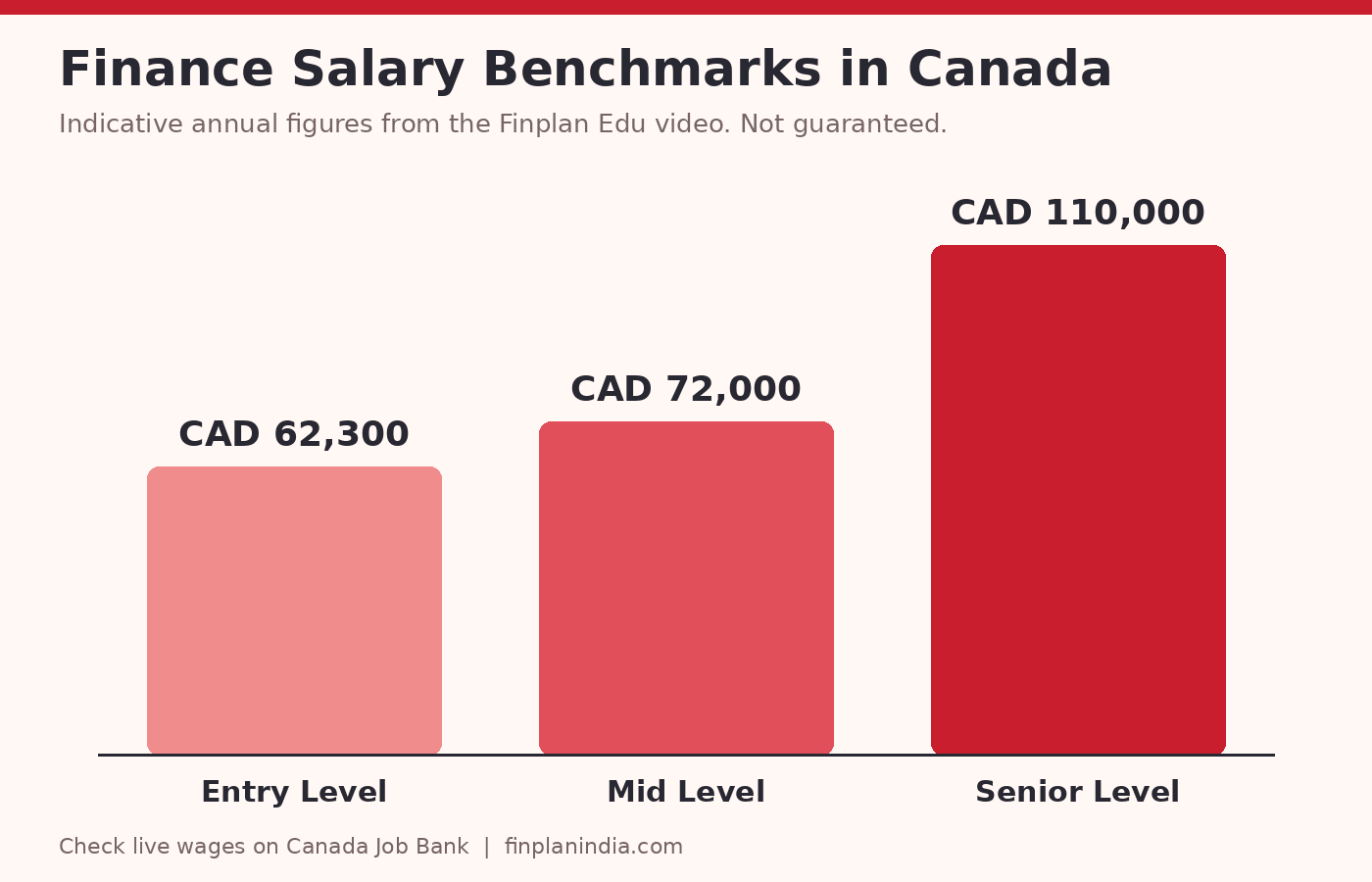
The accompanying Finplan Edu video discusses the following indicative annual salary benchmarks:

Career Stage

Indicative Annual Salary

Entry Level

CAD 62,300

Mid Level

CAD 72,000

Senior Level

CAD 110,000

These figures are benchmarks discussed in the video rather than independently verified national averages or guaranteed salary packages.
A Financial Analyst and a Finance Manager may have considerably different earning potential because their responsibilities and experience requirements differ.
Students should research current occupation-specific wages through the Canadian government's Job Bank before assessing potential job offers.
It is also important to distinguish gross annual salary from take-home income. Taxes and payroll deductions reduce the amount available for monthly expenses and savings.
Rather than converting Canadian salaries directly into Indian rupees, compare expected income with the actual cost of living in your preferred city.

ACCA and Finance Professional Salary in Canada

Best Cities in Canada for Finance Job Opportunities

Choosing where to work in Canada can influence your career opportunities, expenses and professional experience. Toronto, Vancouver, Calgary and Montreal each offer different industry exposure.
Toronto is an established centre for banking, financial services and corporate finance. Vancouver offers opportunities across technology, accounting and corporate businesses.
Calgary may interest professionals exploring finance roles connected to the energy sector. Montreal has a diverse business environment, although French language requirements may affect eligibility for certain positions.

Here are five factors to consider when comparing Canadian cities:

  • Industry opportunities: Identify cities where employers operate in your preferred sector, whether that is banking, technology, energy or professional services.
  • Housing affordability: Research accommodation costs near potential workplaces to understand how much of your monthly income will be spent on rent.
  • Professional qualifications: Check whether employers require Canadian CPA membership or accept relevant international qualifications and professional experience.
  • Language requirements: Review job advertisements carefully, particularly when considering Montreal, where French may be important or required.
  • Long-term career growth: Consider whether the city offers opportunities to change employers, develop specialised skills and progress into senior positions.

A city with attractive job opportunities may also have higher living expenses. The right location depends on how its employment market and lifestyle align with your personal priorities.
Students should compare actual job descriptions and accommodation costs rather than choosing a city based only on its popularity.

Is ACCA Recognised in Canada? Understanding ACCA vs CPA

ACCA provides knowledge in financial reporting, auditing, management accounting, taxation and financial management. These areas are relevant to several international finance careers.
However, students should understand that Chartered Professional Accountant (CPA) is Canada's local professional accounting designation.
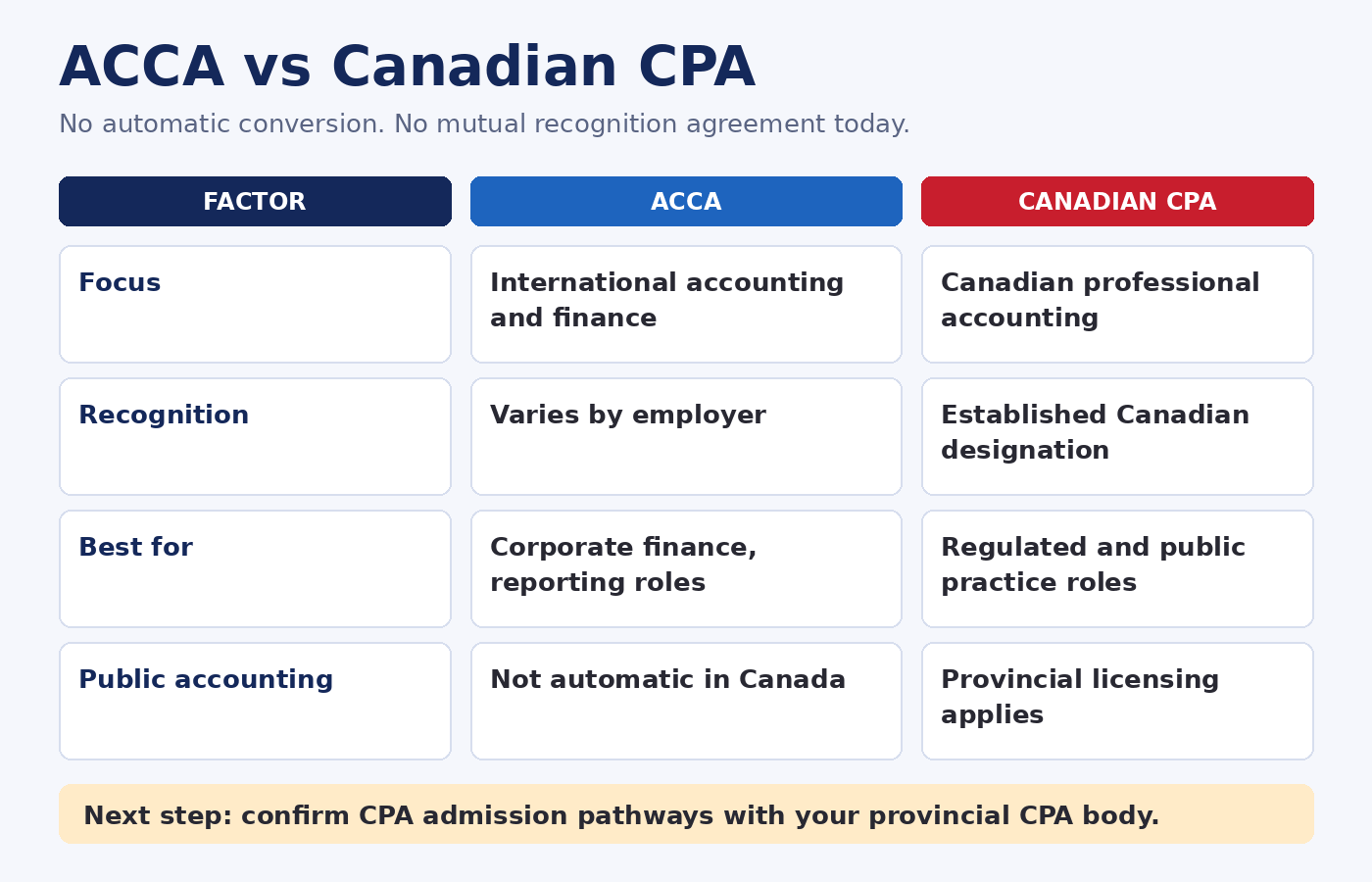
ACCA and Canadian CPA are not automatically interchangeable. According to ACCA's official guidance, there is currently no mutual recognition agreement with CPA Canada.

The following comparison explains important distinctions:

Particular

ACCA

Canadian CPA

Qualification focus

International accounting and finance

Canadian professional accounting

Professional recognition

Varies by employer and jurisdiction

Established Canadian professional designation

Career applications

Corporate finance, reporting and related roles

Accounting, finance and regulated professional roles

Membership

ACCA membership requirements

Applicable Canadian CPA requirements

Public accounting rights

Not automatically granted in Canada

Subject to provincial licensing requirements

Eligible ACCA members may investigate separate CPA admission pathways available to members of international professional accountancy bodies. Requirements should be confirmed with the relevant provincial CPA organisation.
Candidates interested in regulated accounting or public practice must carefully examine local professional requirements before applying.
For corporate finance and analytical roles, employers may evaluate international qualifications alongside relevant experience and technical skills.
Students can consult ACCA's official Moving to Canada guidance for additional information.
Understanding these distinctions helps students make realistic decisions about their future qualifications and career opportunities.


Is ACCA Recognised in Canada? Understanding ACCA vs CPA

Essential Skills to Build a Finance Career in Canada

Developing practical skills alongside ACCA can help students prepare for international finance roles. Employers need professionals who understand financial concepts and can apply them effectively in business situations.
Technical knowledge is important, but communication and commercial understanding also influence professional performance.

Students can focus on developing the following capabilities:

  • Financial reporting knowledge: Strengthen your understanding of financial statements and become familiar with reporting frameworks relevant to Canadian businesses.
  • Excel and financial modelling: Practise using spreadsheets to analyse financial performance, prepare forecasts and evaluate different business scenarios.
  • Data analysis and visualisation: Learn tools such as Power BI to create financial dashboards and communicate important business trends clearly.
  • Commercial awareness: Understand how companies generate revenue, manage costs and respond to changes in their industry.
  • Professional communication: Develop the ability to explain financial findings to managers and colleagues without relying entirely on technical accounting terminology.
  • Canadian business knowledge: Research local financial practices, taxation requirements and regulations relevant to your preferred profession.

Practical projects and internships can provide useful opportunities to apply these skills.
For example, analysing a company's annual report and preparing a financial performance dashboard can demonstrate both accounting knowledge and analytical ability.
Students should aim to build experience they can explain confidently during interviews rather than collecting certifications without practical understanding.

Cost of Living, Work Eligibility and Career Growth in Canada

Building a finance career in Canada requires considering personal finances alongside professional opportunities.
Housing, transportation, groceries, utilities and taxes can significantly influence how much money remains after receiving your salary.
For example, a position offering higher compensation in Toronto may not necessarily provide greater savings than a different opportunity in a less expensive location. Comparing expected take-home income against a realistic monthly budget can help you evaluate job offers.
Employment eligibility is another important consideration. Most foreign nationals require appropriate work authorisation before working in Canada, and completing ACCA does not automatically provide immigration or employment rights.
Students should consult the Canadian government's official work permit guidance before making relocation plans.
Professional growth also takes time. Many individuals begin in accounting or analytical positions before progressing towards business partnering, finance management or controller-level responsibilities.
At Finplan Edu, students in Thane, Mumbai and across India can explore ACCA learning options, examination requirements and professional courses.
Understanding your long-term goals before choosing a country can help you build a career that supports both professional development and financial stability.

Frequently Asked Questions (FAQs)

1. Can ACCA professionals work in Canada?

Yes, ACCA professionals can explore relevant finance roles, subject to employer requirements and appropriate work authorisation. Positions requiring Canadian CPA membership may involve additional qualification requirements.

2. What is the salary of an ACCA professional in Canada?

The Finplan Edu video discusses indicative finance salary benchmarks of CAD 62,300 at entry level, CAD 72,000 at mid level and CAD 110,000 at senior level. Actual compensation varies by position, experience and location.

3. Can ACCA be directly converted into Canadian CPA?

No. There is currently no mutual recognition agreement providing automatic conversion. Eligible ACCA members should explore available admission pathways with the relevant Canadian professional body.

4. Which Canadian city is best for finance professionals?

Toronto is worth exploring for banking and corporate finance. Vancouver, Calgary and Montreal also offer opportunities depending on your preferred industry, language skills and lifestyle requirements.

5. Can fresh ACCA graduates get jobs in Canada?

They can apply for suitable entry-level opportunities if they meet employer and work eligibility requirements. Practical experience and knowledge of local financial practices can improve career readiness.

6. What skills are useful for finance jobs in Canada?

Financial reporting, Excel, financial modelling, data analysis, commercial awareness and communication are useful skills. Familiarity with Canadian accounting practices may also be helpful.

7. Can I pursue ACCA in India before planning a career in Canada?

Yes. Students can explore classroom learning or online classes in India before researching international opportunities. Review the ACCA examination pattern, fees, certification requirements and practical experience criteria before enrolling.


Start Preparing for Your Global Finance Career

Want to understand finance careers in Canada, salary expectations, job opportunities, and career growth in more detail? πŸ‡¨πŸ‡¦πŸ“Š

πŸŽ₯ Watch the full YouTube video:
https://youtu.be/wE5s6G8d3pw?si=4pWf-Lc1hJsbsR4f

If you're searching for ACCA classes near me or exploring international finance career opportunities, connect with Finplan Edu for guidance on your ACCA qualification and learning journey.

πŸ“ Visit us: Google Maps
πŸ“§ Email: enquiries@finplanindia.com
πŸ“ž Call: 9029007248

Have questions? Contact us