
Your Global Finance Career is Loading…

ACCA Exemptions: How to Strengthen Your Basics Before Advanced Exams in 2026

Taking ACCA exemptions can reduce the number of examinations you need to complete. However, some students discover that skipping earlier papers leaves gaps in their understanding when they begin preparing for advanced examinations.You might be studying Strategic Business Reporting (SBR) and suddenly struggle to remember journal entries. Financial ratios may take longer than expected, or concepts from management accounting might seem unfamiliar. These challenges become especially stressful when an examination is only a few weeks away. The good news is that you do not need to study every exempted paper again. With targeted revision, appropriate resources, and regular question practice, you can strengthen the concepts required for your current examination.This guide explains how to recover weak accounting basics after ACCA exemptions without losing valuable preparation time.
Quick Snippets

ACCA Exemptions: How to Strengthen Your Basics Before Advanced Exams

Why Do ACCA Students Struggle After Taking Exemptions?

ACCA exemptions allow eligible students to avoid certain examinations based on their previous academic qualifications. Students who have completed recognised degrees or professional courses may qualify for exemptions from specific papers.
Although exemptions recognise previous learning, they do not necessarily mean every concept is fresh in a student's memory.
For example, a student may have studied financial accounting during graduation but may not have practised consolidation or journal entries recently. These topics become important again when preparing for advanced financial reporting.
The ACCA qualification builds on knowledge developed through earlier subjects. Financial reporting, performance management, and financial management concepts frequently appear again at higher levels.
Students sometimes struggle because they move directly into advanced questions without revisiting the underlying principles.
This does not mean taking exemptions was necessarily a mistake. It means students need to assess their existing knowledge before attempting more complex applications.
A few weeks of focused revision can help identify forgotten concepts and improve understanding without repeating entire examinations.

Identify the Foundation Concepts Related to Your Current ACCA Paper

One of the biggest mistakes students make after receiving ACCA exemptions is attempting to revise every subject they skipped.

This approach consumes valuable time and can distract students from preparing for their upcoming examinations.

Instead, begin by identifying the foundational knowledge directly connected to your current paper. Each advanced ACCA subject builds on particular accounting, financial management, or performance management concepts.

For example, students preparing for SBR should understand relevant financial accounting principles and financial reporting standards. Those studying AFM need a strong understanding of financial management calculations.

Start by identifying the areas that regularly appear in your current syllabus:

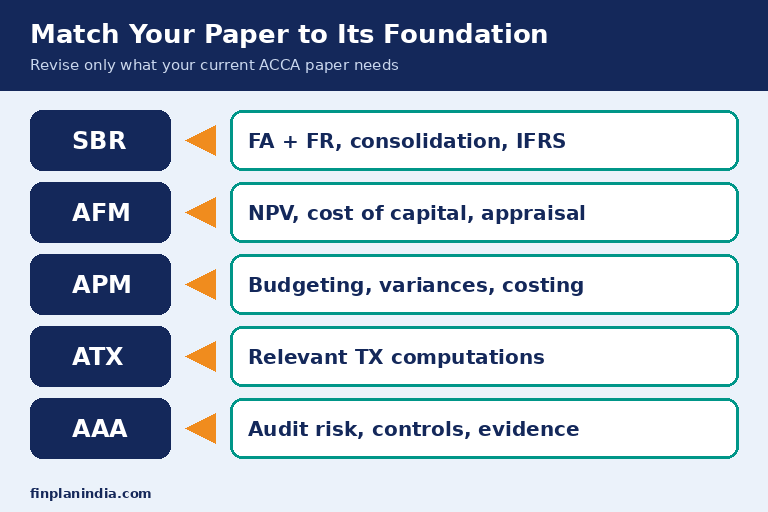
  • SBR Preparation: Revise relevant Financial Accounting (FA) and Financial Reporting (FR) concepts, including double-entry principles, consolidation, and accounting standards.

  • AFM Preparation: Focus on Financial Management (FM) fundamentals such as net present value, cost of capital, investment appraisal, and capital structure.

  • APM Preparation: Strengthen Management Accounting (MA) and Performance Management (PM) concepts, including budgeting, variance analysis, and costing methods.

  • ATX Preparation: Review the relevant Taxation (TX) syllabus, including applicable income tax, corporation tax, and other tax principles for your examination variant.

  • Audit Preparation: Revisit audit risk, internal controls, audit evidence, and audit procedures before tackling more advanced audit questions.

Students should prioritise concepts relevant to their examination variant and current syllabus. This selective approach makes revision more manageable while allowing sufficient time for advanced examination practice.

ACCA exemptions

Focus on High-Value Concepts Instead of Repeating the Entire Syllabus

ACCA students often feel tempted to download an entire foundation-level textbook when they notice gaps in their knowledge. However, completing hundreds of pages of introductory material may not be the most productive approach when examination time is limited.
A better strategy is to identify concepts that repeatedly appear across different levels of the qualification. These concepts form the foundation for more advanced questions.For example, understanding double-entry accounting supports financial reporting, while knowing investment appraisal principles helps with financial management decisions.

The table below highlights useful connections between foundational and advanced subjects:

Current ACCA Paper

Foundation Knowledge to Revise

Why It Matters

SBR

FA and FR concepts, consolidation, IFRS principles

Supports advanced financial reporting analysis

AFM

NPV, cost of capital, investment appraisal

Helps evaluate complex financial decisions

APM

Budgeting, variances, performance measurement

Supports strategic performance evaluation

ATX

Relevant TX concepts and tax computations

Provides the basis for advanced tax planning

AAA

AA concepts, audit risk, internal controls

Supports advanced audit and assurance analysis


Not every topic requires equal revision time. Some concepts may already be familiar, while others need additional attention.
Students should use their performance in practice questions to determine which topics deserve priority. If you understand a concept but take too long to apply it, practise related questions. If you cannot explain the concept at all, revisit its underlying theory.

The goal is to build sufficient understanding for advanced applications rather than master every detail of an exempted paper.

Use Targeted Study Resources to Recover Your ACCA Basics

Choosing appropriate revision materials can make a significant difference when preparing for advanced ACCA examinations. Students often spend too much time searching for resources or watching lengthy lectures without testing their understanding.
Instead, select concise materials that address specific weaknesses. The ACCA Study Hub provides syllabus-related learning content, while other educational platforms offer additional explanations and examples.
Free resources can be useful when combined with structured question practice.

Consider these study methods:

  • ACCA Study Hub: Use official learning content to revisit relevant concepts and connect them with your current syllabus.

  • OpenTuition Notes: Refer to concise study notes and lectures for subjects such as Financial Accounting and Management Accounting.

  • Topic-Specific YouTube Videos: Search for individual concepts such as ACCA FA Bank Reconciliation or ACCA MA Marginal Costing Basics.

  • Short Revision Sessions: Spend approximately 20 to 30 minutes reviewing one concept before testing your understanding.

  • Personal Revision Notes: Write short explanations, formulas, and examples that can be reviewed before examination practice.

  • Practice Questions: Attempt relevant questions immediately after revising each topic to confirm whether you can apply the concept.

Avoid watching multiple videos covering the same topic unless additional explanations are genuinely required.
One clear explanation followed by active practice is usually more useful than repeatedly consuming similar content.
Students should also prioritise official ACCA study resources and examination guidance when checking syllabus requirements.

Create a Personal ACCA Basics Recovery Plan

A structured recovery plan helps students revise systematically instead of switching randomly between subjects. Begin by listing the concepts that currently cause difficulty. Your list might include double-entry accounting, depreciation, ratios, marginal costing, or financial management calculations. Next, classify each topic according to how well you understand it. This helps distinguish concepts requiring complete revision from those needing only additional practice.

You can create a simple tracker using Excel, a notebook, or a notes application.

Weak Area

Current Difficulty

Revision Action

Progress Check

Double Entry

Journal entries are confusing

Revise accounting rules and examples

Attempt short journal questions

Financial Ratios

Slow interpretation

Review formulas and financial meaning

Practise ratio analysis

Depreciation

Unclear calculations

Revise relevant accounting treatment

Solve calculation questions

Marginal Costing

Weak conceptual understanding

Review contribution and costing principles

Attempt application questions

NPV

Difficulty with investment appraisal

Revise discounting and cash flows

Solve investment appraisal problems


This tracker helps students direct their attention towards genuine weaknesses. For students with approximately six weeks remaining before examinations, a practical approach is to dedicate limited revision sessions to foundation concepts while continuing their main paper preparation.
Students should not postpone advanced question practice until they feel completely confident about every basic topic.
Review your progress regularly and adjust the plan according to mistakes identified during practice.

Combine Concept Revision With Active Question Practice

Understanding a concept while watching a lecture does not necessarily mean you can apply it correctly during an examination.

ACCA advanced papers assess your ability to interpret information, apply technical knowledge, and respond to practical scenarios.

This is why passive revision should be followed by active learning.

Students should attempt relevant questions soon after revising foundational concepts. This reveals whether the information has been understood or merely recognised.

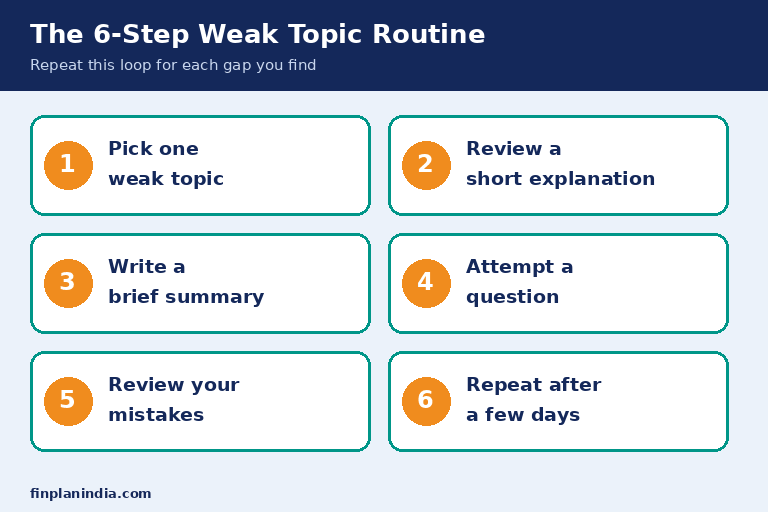
A practical revision routine can include the following steps:

  • Identify One Weak Topic: Choose a concept connected to your current examination rather than revising unrelated subjects.

  • Review the Explanation: Use concise notes or a short lesson to understand the main principles and calculations.

  • Write a Brief Summary: Record important formulas, accounting treatments, or explanations in your own words.

  • Attempt a Question: Apply the concept through a relevant practice question without immediately referring to the solution.

  • Review Your Mistakes: Identify whether errors occurred because of weak knowledge, incorrect calculations, or misunderstanding the question.

  • Repeat When Necessary: Return to difficult concepts after a few days to check whether you can apply them independently.

Students should remember that speed generally improves through repeated practice.
Initially, focus on understanding why an answer is correct. Once the concepts become clearer, introduce timed examination practice. This approach helps students strengthen foundational knowledge while developing the application skills required for advanced ACCA papers.


A practical revision routine

How Finplan Edu Can Help Students Prepare After ACCA Exemptions

Recovering weak basics takes a clear plan, steady revision, and regular practice. Some students manage this alone, while others prefer guidance to spot gaps and organise their schedule. At Finplan Edu, students pursuing ACCA can explore structured exam preparation, concept-focused learning, and study planning support. Students in Thane, Mumbai, and across India can ask about ACCA offline courses as well as ACCA online courses. Before choosing any course, compare fees, exam patterns, academic support, and qualification requirements. You can also read the IFRS Foundation website for the standards behind SBR. When you speak to any provider, ask about:

Teaching format: Check whether classes are live, recorded, or a mix, and whether that suits your routine.
Doubt support: Find out how quickly you can get answers when a basic concept blocks you.
Practice material: Ask how many exam-style questions you get and whether they come with feedback.
Batch timing: Confirm that schedules fit around your job or college hours.
Fees and extras: Get a clear view of total cost, including materials and mock exams.

You can reach Finplan Edu on 9029007248, at enquiries@finplanindia.com, or find the centre on Google Maps.

Frequently Asked Questions (FAQs)

1. Do ACCA exemptions make advanced examinations more difficult?

Not necessarily. Exemptions recognise previous academic learning, but students may need to revise certain concepts before attempting advanced papers. Targeted revision can help address these knowledge gaps.

2. Should students study exempted ACCA papers again?

Students usually do not need to repeat the complete syllabus of exempted papers. Revising relevant foundational concepts connected to their current examination is generally more practical.

3. Which subjects should students revise before ACCA SBR?

Students preparing for SBR should review relevant Financial Accounting and Financial Reporting concepts, including consolidation, accounting standards, and financial statement preparation.

4. What should students revise before ACCA AFM?

Important foundational topics include investment appraisal, net present value, cost of capital, capital structure, and other Financial Management concepts.

5. Can ACCA basics be improved within six weeks?

Students may improve their understanding through focused revision and regular question practice within six weeks. However, progress depends on their existing knowledge, available study time, and the complexity of their weaknesses.

6. What free resources help with ACCA foundation revision?

Students can explore the ACCA Study Hub, OpenTuition notes and lectures, and educational YouTube videos covering specific accounting concepts. Official ACCA resources should be used to confirm examination requirements.

7. How can students prepare for advanced ACCA papers after exemptions?

Start by identifying weak concepts, reviewing relevant foundation topics, maintaining a revision tracker, and practising questions regularly. Structured guidance can also help students prepare more effectively.

Strengthen Your ACCA Basics and Prepare With Confidence

Taking exemptions can help reduce your examination workload, but understanding the underlying concepts remains important for advanced ACCA preparation.

If you need support with study planning, concept revision, or examination strategy, explore Finplan Edu for ACCA guidance and available learning options.

Taken ACCA exemptions but struggling with advanced papers? Watch the full YouTube video on Finplan Edu's channel!
The video explains how to identify weak foundation concepts, choose relevant revision resources, build a focused study plan, and prepare for higher-level ACCA examinations without starting from scratch.

Have questions? Contact us