Your Global Finance Career is Loading…

What Happens If You Fail Your ACCA Exam? 5 Ways to Manage the Fear Before It Happens

Most ACCA students carry some version of the same fear before a professional-level exam, especially papers like SBR, APM, or SBL. It's rarely just about the exam itself. It's the imagined conversation with a skeptical boss, the worry about disappointing a team, or the quiet fear that a failed sitting means falling behind everyone else. That fear is normal, and it's mostly based on scenarios that feel bigger in your head than they actually are. This guide walks through what genuinely happens if you fail, and a few practical ways to manage the anxiety before results day even arrives.

Quick Snippets

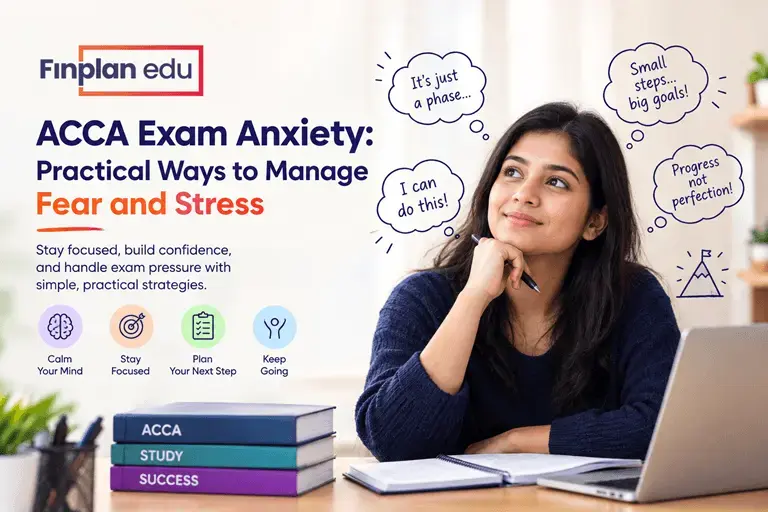
Finplan Edu ACCA exam anxiety guide with tips to manage stress and build confidence.

Write Down Your Worst-Case Scenarios, Then Find the Lesson in Each

One of the most effective ways to deal with exam anxiety isn't avoiding the fear, it's writing it down instead of turning it over vaguely in your head. Vague worry stays big because it never gets examined closely. A written worst-case scenario, on the other hand, can be looked at, questioned, and reframed into something useful. The exercise is simple: list your worst fears about failing, however unlikely or dramatic they feel, and find one real lesson hiding inside each one. Here's what that looks like for common ACCA fears.


●    Disappointing your team or junior staff. If people report to you, worrying about letting them down is natural, but pushing through a professional paper while managing a team is already proof of the kind  of resilience good leaders need.

●    Facing a boss who doubts you can pass. Even attempting a professional-level paper during a demanding work period, and scoring respectably, shows real effort most colleagues wouldn't take on at all, and that's worth saying out loud if it comes up.

●    Delayed career progression. A few extra months before your next sitting rarely changes your actual trajectory in any meaningful way, especially compared to the alternative of not attempting the exam at all.

●    Losing money on exam fees. It helps to treat a resit fee as tuition for the next attempt rather than a loss, since the knowledge you built while preparing carries forward regardless of the result.

●    Being judged by peers who passed. Nobody remembers which sitting someone passed a professional paper on five years into their career, they remember who kept showing up and eventually qualified.

What Actually Happens If You Fail an ACCA Exam

For most professional-level ACCA candidates, a failed sitting isn't the career-ending event it feels like in the moment. Whether you resit through the normal cycle or wait for the next sitting, the real consequence usually comes down to extra study time and an additional exam fee, not a derailed career. Scoring in the 30-to-40-mark range on a failed attempt still reflects genuine effort and knowledge, particularly if you were juggling full-time work or family responsibilities alongside preparation. That attempt isn't wasted either. A failed sitting is a real chance to revisit standards, IFRS content in SBR technical being a good example, that will directly help in later papers like APM. The table below breaks down what a failed attempt genuinely costs against what it doesn't touch at all.

Area

What You Lose

What You Don't Lose

Time

A delay until your next available sitting

Knowledge already built, or PER progress made

Money

The cost of one resit exam fee

Your overall career trajectory or job security

Confidence

A short-term dent, usually temporary

Your actual competence, shown by your score

Career progression

Rarely affected, unless the pattern repeats

Employer trust, if you're upfront about it

Why ACCA Exams Feel So High-Stakes in the First Place

It's worth understanding why these exams carry so much emotional weight, because the pressure isn't accidental. ACCA professional-level papers are designed to prepare candidates for senior management roles, the kind where you're eventually making high-stakes decisions with real financial consequences and far less oversight than earlier in your career. Learning to manage stress and perform under pressure during exams is, in a strange way, part of the actual training for that future role. That doesn't make the anxiety pleasant, but it does make it purposeful rather than random. Recognizing this can shift how you relate to exam stress, from something to eliminate entirely to something you're learning to work alongside, which is closer to what the job itself will eventually demand.

Talk to the Right People About Your Exam Anxiety

Talking about exam fear genuinely helps, but who you talk to matters just as much as whether you talk at all. Exam forums and fellow ACCA candidates, while well-intentioned, can sometimes amplify anxiety rather than ease it, since everyone in that space is processing their own version of the same fear. Choosing the right kind of support changes how effective this is.

●    Pick people outside the ACCA world. A partner, close friend, or family member who isn't sitting exams themselves tends to offer perspective rather than shared panic, which is usually what you need in the moment.

●    Avoid exam forums right around results day. These spaces are useful for study resources, but they can turn into an anxiety echo chamber exactly when you need calm the most.

●    Separate your identity from the outcome in conversation. Saying "I sat SBR this session" instead of "I might have failed" keeps the exam as one event rather than a verdict on who you are.

●    Talk to someone who cares about you as a person, not your score. The right listener asks how you're doing, not just what mark you expect, and that distinction genuinely changes how supported you feel.

●    A mentor or counsellor works just as well if you don't have the right peer. You don't need someone who understands ACCA specifically, you need someone who's good at helping you think clearly under stress.

Finplan Edu ACCA exam anxiety guide showing student mentorship and emotional support.

What Happens When You Walk Into the Room Anyway

It helps to rehearse the conversation you're dreading, rather than just imagining it in the abstract. Picture the skeptical boss scenario directly: even if you don't pass, sitting the exam and scoring a respectable mark while managing work and family pressures is real evidence of effort and capability. Walking someone through that context, calmly and factually, usually lands better than you expect, because most reasonable managers respect the attempt itself, not just the outcome. The act of showing up despite the fear is, on its own, worth something concrete on your professional record, even before the result comes in.

Start Planning for the Next Sitting Before You Even Get Results

One of the most practical habits you can build is starting ACCA preparation for your next sitting immediately after finishing the current one, while the material and momentum are still fresh, even if it's just light review at first. This matters more than it sounds, because professional-level ACCA results often come down to marginal passes and question-variant luck rather than a clean gap in knowledge. Papers like SBR, APM, and SBL use different exam variants across sittings, meaning the specific case study or scenario you get can genuinely affect how the exam feels on the day. Continued study between sittings increases your odds significantly, whether you're resitting one paper or attempting two in your next session.


Paper

Full Form

Why Variant Luck Matters

SBR

Strategic Business Reporting

Different case study variants each sitting change which standards come up most heavily

APM

Advanced Performance Management

Variants test different performance frameworks, so familiarity with all of them matters

SBL

Strategic Business Leader

The case study variant shifts which competencies and business scenarios get tested

AFM

Advanced Financial Management

Variant-specific numerical scenarios can shift the practical difficulty of a sitting

AAA

Advanced Audit and Assurance

Variant case studies change which audit risk areas get the most focus

Finplan Edu offers ACCA online and offline courses across Mumbai, Pune, Hyderabad, Thane, Bangalore, Chennai, Delhi, Kerala, and Surat, so support is available wherever you're studying from.

A Quick Action Plan for Exam Week Anxiety

If you're currently anxious about an upcoming attempt or waiting on results from a recent one, it helps to have a short, concrete list of actions rather than just sitting with the worry. None of these take long, and each one directly addresses one of the fears covered above.


●    Write your top ten fears down tonight. Not tomorrow, not in your head while trying to fall asleep, written out where you can look at them and reframe each one.

●    Book time with someone outside ACCA before results day. A short conversation scheduled in advance is far more useful than hoping you'll reach out if things feel hard later.

●    Start reviewing your weakest topic area today, regardless of the result. This works whether you're waiting on results or already know you're resitting, since the material will help you either way.

●    Decide in advance how you'll respond if a boss or colleague asks about your result. Having a calm, factual answer ready means you won't be caught off guard by a question you were already dreading.

●    Remind yourself these are marginal-pass, variant-luck exams. A single result is not a clean measure of your ability, and treating it that way only adds pressure that isn't warranted.

Frequently Asked Questions

What happens if I fail an ACCA exam like SBR?

In most cases, it means an extra exam fee and some additional study time before your next attempt, not a derailed career. Many students who fail a professional paper pass comfortably on the next sitting.

Will failing a professional-level paper delay my career significantly?

Rarely, unless it becomes a repeated pattern. A single failed sitting typically costs a few months of timeline, not a meaningful setback to your overall career progression.

Why do different students get different SBR or APM exam variants?

ACCA uses multiple case study or scenario variants for professional-level papers within a single sitting, which means the specific content you're tested on can differ from another student's paper in the same exam window.

Should I start studying for my next exam before I get my results?

Yes, ideally. Starting light review immediately after your current exam keeps your knowledge fresh and improves your odds significantly if you end up resitting or attempting a new paper.

Who should I talk to if I'm anxious about ACCA results?

Someone outside the ACCA community tends to help more than exam forums or fellow candidates, since they can offer calm perspective instead of shared anxiety.

Is it normal to feel this much pressure during ACCA exams?

Yes, and it's not accidental. Professional-level ACCA papers are designed to prepare you for high-stakes management roles, so learning to manage pressure now is part of the actual preparation.


Feeling the Pressure Ahead of Your Next ACCA Attempt?

Exam anxiety gets a lot more manageable with the right study plan and someone to talk it through with. Whether you're preparing for SBR, APM, SBL, or planning your next sitting after a resit, structured guidance makes a real difference, wherever you're currently studying from.
Our team at Finplan India is happy to talk through your study plan, your next sitting, or just where to start. Reach out at enquiries@finplanindia.com or call 9029007248, or drop by our office to talk it through in person.

Have questions? Contact us