

Your Global Finance Career is Loading…

Master the 3 Golden Rules of Accounting in One Easy Sitting

Accounting becomes very effortless when you understand how financial transactions are recorded. Whether a business purchases equipment, pays employee salaries or receives money from a customer every transaction must be entered correctly in its books. This is where the 3 golden rules of accounting become important. If you are studying commerce or pursuing a B.Com degree or preparing for professional qualifications such as ACCA learning these rules will help you build a strong foundation in accounting. But what are those 3 accounting golden rules and how do you apply them to everyday business transactions? Let us understand their meaning, examples and practical applications.
Quick Snippets

Master the 3 Golden Rules of Accounting in One Easy Sitting by Finplan Edu

Key Takeaways

  • Personal, real and nominal accounts are what the 3 golden rules of accounting about.

  • Personal accounts are about debiting the receiver and crediting the giver.

  • Real accounts are all about debiting what comes in and crediting what goes out.

  • Nominal accounts are about debiting all expenses and losses and crediting all incomes and gains.

What Are The 3 Golden Rules Of Accounting?

The 3 golden rules of accounting are basic principles used to record financial transactions accurately. They help accountants decide which account should be debited and which should be credited.

These rules form part of the traditional approach to double entry bookkeeping where every transaction has at least two corresponding entries.

When a firm purchases furniture with cash for instance the furniture account is debited since an asset has gone into the business. Since money leaves their company the cash account is credited.

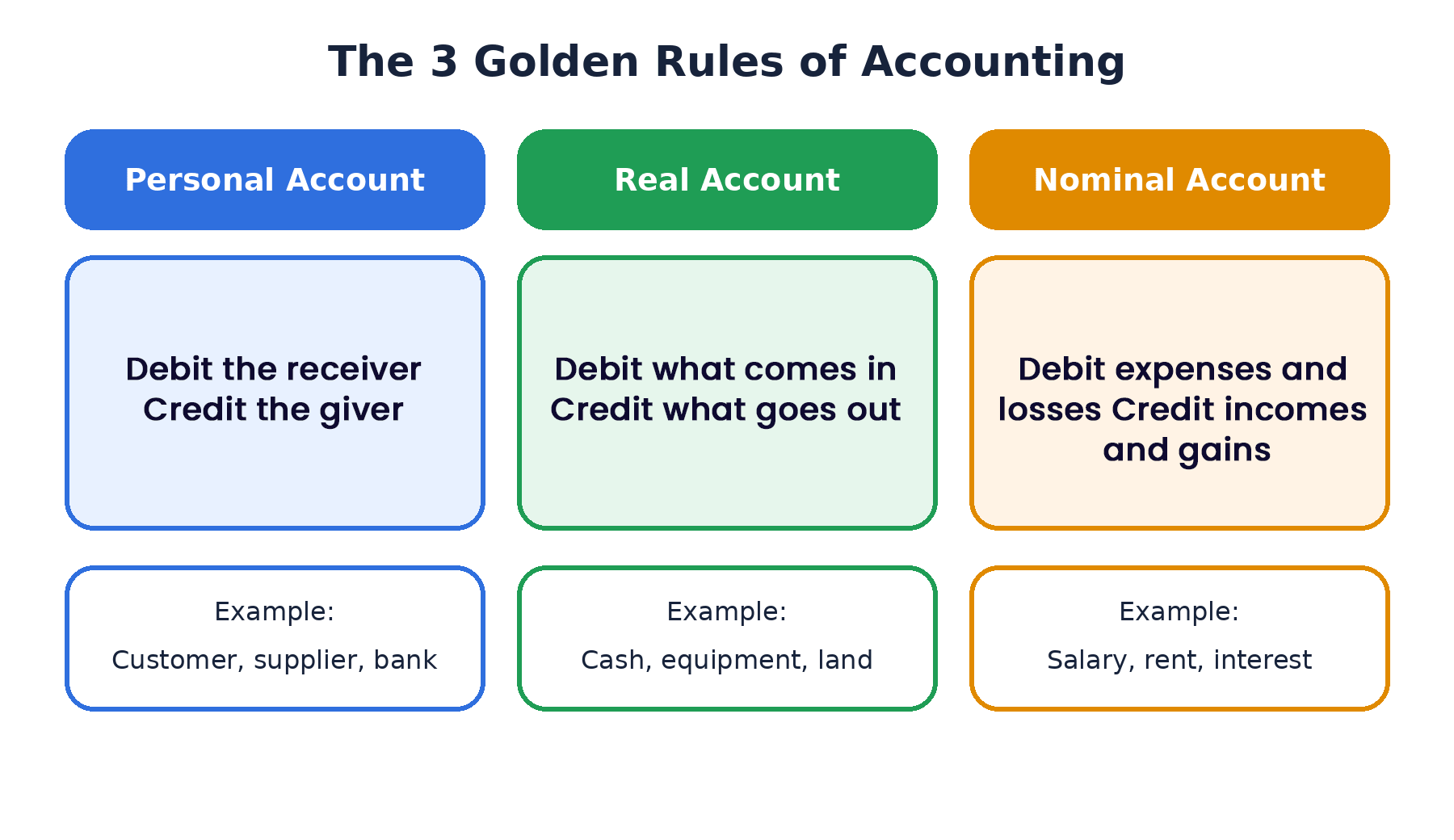
The three golden rules are:

Account Type

Golden Rule

Simple Example

Personal Account

Debit the receiver and credit the giver

Recording a payment made to a supplier

Real Account

Debit what comes in and credit what goes out

Purchasing office equipment

Nominal Account

Debit all expenses and losses and credit all incomes and gains

Recording salary expenses


3 Golden Rules Of Accounting

Personal Account Meaning

A personal account records transactions involving individuals, businesses, companies and other entities.

For example a customer's account, a supplier's account and a bank's account can be treated as personal accounts under the traditional classification.

The golden rule for personal accounts is

Debit The Receiver And Credit The Giver

It suggests that you credit the account of the person or entity providing the item and debit the account of the person or entity receiving it.

Example Of A Personal Account

Suppose a business purchases goods worth ₹10000 from a supplier on credit.

The supplier provides the goods but the business has not paid for them yet. Therefore the supplier becomes a creditor and the business must record the amount payable.

The journal entry is:

Particulars

Debit (₹)

Credit (₹)

Purchases Account

10000

—

Supplier's Account

—

10000

Total

10000

10000

The purchases account is debited because the business has purchased goods. The supplier's account is credited because the supplier has provided the goods on credit.

When the business later pays the supplier the entry will be:

Particulars

Debit (₹)

Credit (₹)

Supplier's Account

10000

—

Bank Account

—

10,000

Total

10000

10000

The supplier's account is debited because the outstanding amount is being settled. Additionally the bank account is credited as funds depart the company.

Where Are Personal Accounts Used?

Personal accounts are useful when recording transactions involving

  • Customers who purchase goods or services on credit.

  • Suppliers from whom a business purchases goods.

  • Banks through which businesses receive or make payments.

  • Companies or individuals who lend money to a business.

Real Account Meaning

A real account records assets owned by a business. These assets may be tangible such as machinery and furniture or intangible such as patents and certain software rights.

The golden rule for real accounts is

Debit What Comes In And Credit What Goes Out

An asset's account gets deducted when it enters a business. Additionally when an asset departs the company the account is credited.

Example Of A Real Account

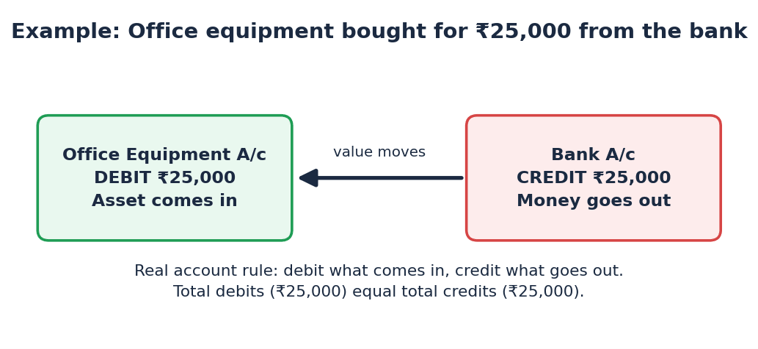
Suppose a company purchases office equipment worth ₹25000 and pays for it immediately through its bank account.

Equipment is delivered to the firm while funds are taken out of its bank account.

The journal entry is:

Particulars

Debit (₹)

Credit (₹)

Office Equipment Account

25000

—

Bank Account

—

25000

Total

25000

25000


Example Of A Real Account

The office equipment account is debited because an asset enters the business. Additionally the bank account gets credited when money is sent.

This transaction increases the company's equipment assets and reduces its bank balance.

Where Are Real Accounts Used?

Real accounts are commonly associated with transactions involving

  • Cash and bank balances

  • Furniture, machinery and office equipment

  • Buildings and land

  • Inventory and other assets

  • Eligible intangible assets such as patents

However remember that not every transaction involving an asset follows the traditional real account rule.

What About Rent Paid In Advance?

Suppose a business pays ₹12000 for next month's rent.

The amount relates to a future period so it is initially recorded as a prepaid rent asset rather than an ordinary rent expense.

The entry is:

Particulars

Debit (₹)

Credit (₹)

Prepaid Rent Account

12000

—

Bank Account

—

12,000

Total

12000

12000

When the rental period is completed the relevant amount is transferred from prepaid rent to rent expense.

Nominal Account Meaning

Nominal accounts record expenses, losses, incomes and gains incurred or earned by a business during an accounting period.

The golden rule for nominal accounts is

Debit All Expenses And Losses And Credit All Incomes And Gains

This rule helps businesses record their financial performance and calculate profit or loss for a particular period.

Example Of A Nominal Account

Suppose a business pays ₹3000 for its monthly electricity bill.

Electricity is an expense incurred while running the business. Therefore the electricity expense account is debited and the bank account is credited.

The journal entry is:

Particulars

Debit (₹)

Credit (₹)

Electricity Expense Account

3000

—

Bank Account

—

3000

Total

3000

3000


Now consider another example.
Suppose the business earns ₹2000 as interest income which is credited directly to its bank account.

The journal entry is:

Particulars

Debit (₹)

Credit (₹)

Bank Account

2000

—

Interest Income Account

—

2000

Total

2000

2000

The bank account is debited because money comes in. The interest income account is credited because the business has earned income.

Where Are Nominal Accounts Used?

Nominal accounts help record

  • Salary and wages expenses

  • Rent and electricity expenses

  • Advertising and transportation costs

  • Sales revenue and service income

  • Interest income

  • Losses and gains arising from business activities

These accounts help businesses determine their financial performance. Their balances are generally closed to the relevant profit and loss accounts at the end of the accounting period.

3 Golden Rules Of Accounting Examples

The following examples show how the three golden rules of accounting work in everyday business situations:

Business Transaction

Debit Account

Credit Account

Main Principle

Paid employee salary of ₹20000

Salary Expense

Bank

Expenses are debited

Purchased equipment for ₹30000 in cash

Equipment

Cash

What comes in is debited

Received a bank loan of ₹50000

Bank

Bank Loan

Money received and liability recognised

Paid electricity bill of ₹2500

Electricity Expense

Bank

Expenses are debited

Earned interest income of ₹1500

Bank

Interest Income

Income is credited

Paid a supplier ₹8000

Supplier

Bank

Personal account is debited

Paid rent in advance of ₹10000

Prepaid Rent

Bank

Prepayment is recorded as an asset

Notice that each transaction has a debit and a credit of equal value.

Also not every entry can be explained using only one golden rule. A single transaction may involve different account types so you must identify each account and apply the appropriate principle.

How Do The Golden Rules Apply In Practical Accounting

Here are some practical applications

1. Recording Accounts Payable and Accounts Receivable

Businesses often sell goods on credit or purchase supplies without making immediate payments.

Personal accounts help track the amounts customers owe the business and the amounts the business owes its suppliers.

For example when goods are sold to a customer on credit the customer's account is debited and sales revenue is credited.

When the customer pays later the bank account is debited and the customer's account is credited.

2. Tracking Business Assets

Real accounts help businesses record assets such as equipment, furniture and machinery.

Accurate asset records help businesses understand what they own and support the preparation of their balance sheets.

They are also useful when recording asset purchases and disposals.

3. Calculating Profit And Loss

Nominal accounts help businesses record revenue and expenses during an accounting period.

Comparing recognised income with expenses helps determine whether the business has earned a profit or incurred a loss.

These records support the preparation of the income statement also known as the profit and loss statement.

4. Maintaining Accurate Financial Records

Correctly classifying transactions reduces the risk of posting amounts to the wrong accounts.

Combined with double entry bookkeeping the golden rules help maintain organised ledgers and support the preparation of financial statements.

However balanced entries alone do not guarantee accuracy. Transactions must also be classified correctly and supported by appropriate documentation.

5 Common Mistakes Students Should Avoid

1. Confusing account types

Before recording a transaction identify whether each account is personal, real or nominal under the traditional classification.

2. Assuming every cash payment is an expense

Buying machinery is generally an asset purchase not an immediate operating expense. Similarly rent paid in advance is initially recorded as a prepaid asset.

3. Forgetting the second entry

Every transaction under double entry bookkeeping must have corresponding debit and credit entries.

4. Memorising without practising

Knowing the rules by heart is useful but you also need to apply them to different business situations.

5. Ignoring adjustments

Transactions such as accrued expenses, prepaid expenses and depreciation may require adjustments to ensure financial statements reflect the correct accounting period.

How Can You Avoid These Mistakes?

  1. Read the transaction carefully.

  2. Identify the accounts involved.

  3. Classify each account using the traditional account categories.

  4. Determine which account should be debited and credited.

  5. Record the journal entry with equal debit and credit amounts.

  6. Check whether the transaction has been recorded in the correct accounting period.

How To Learn the Golden Rules Of Accounting Effectively

If you are new to accounting you do not need to memorise every possible journal entry at once.

Start by understanding the purpose of each account type and practise a few transactions every day.

You can also create a revision table containing the three rules their meanings and one example for each.

Once you understand the basics move on to journal entries, ledger posting, trial balances and financial statements. This will help you see how individual transactions connect with the larger accounting process.

Students preparing for professional qualifications such as ACCA can also benefit from practising accounting questions regularly. A clear understanding of debit and credit principles provides a useful foundation for more advanced financial reporting topics.

The goal is not simply to remember which side to use. It is to understand why a particular account is debited or credited.

Frequently Asked Questions

1. Why are the golden rules of accounting important?

They help students and accountants record financial transactions systematically. Applying them correctly supports accurate journal entries, organised ledgers and reliable financial statements.

2. How is equipment recorded under the golden rules?

When equipment is purchased for cash the equipment account is debited because the asset comes into the busines, while the cash account is credited because money goes out.

3. How does the golden rule for nominal accounts work?

Expenses and losses are debited while incomes and gains are credited. For example salary expense is debited when employee salaries are recognised while sales revenue is credited when sales are recognised.

4. Are the golden rules enough to learn accounting?

They provide a useful starting point, but accounting also requires an understanding of journal entries, ledger accounts, adjustments, trial balances and financial statements.

5. Do the golden rules apply to every accounting transaction?

The rules are a traditional framework for classifying accounts and deciding debit and credit entries. Modern accounting also relies on accounting standards and the underlying principles of assets, liabilities, equity, income and expenses. Understanding both approaches is important as you progress.

Grow Your Accounting Knowledge With Finplan Edu

The 3 golden rules of accounting come down to one habit: identify the account type, then apply its rule. Debit the receiver and credit the giver for personal accounts, debit what comes in and credit what goes out for real accounts, and debit expenses and losses and credit incomes and gains for nominal accounts. Practise these on a few transactions every day and you will handle most journal entry questions with confidence.

If you want a clear learning path from here, speak to the Finplan Edu team or email enquiries@finplanindia.com. You can also find us on Google Maps. Explore ACCA online and offline courses at Finplan Edu and build the accounting and reporting skills that employers look for.

Have questions? Contact us